
Understanding Fields: Form, Formatting, and Utility Field Explanations
Fields are the individual data elements that makeup forms. You can think of them as a container for a type of information. They are the building blocks the Forms Module uses to collect, store, and process data in a structured way.
Every field has properties (or metadata) that define it: a Name/Identifier (what the field is called internally), the Data Type (what kind of data it can hold), Constraints (the rules that limit what data is valid), Default Value (what to use if no data is entered), and Validation Rules (checks to ensure the input meets expectations, e.g., email format, numeric range).
In KAStrack, individuals with Admin Access Levels can define custom fields that appear as form inputs that can be utilized in structured formats. There are three field types utilized in the Forms Module: form fields, formatting fields, and utility fields. Users can also reference data from a database in a field.
A form field can only have one field type. If you need to utilize another (e.g., for formatting purposes), you can set the displayed label to be same but the field label must be unique.
Form Fields
A form field is an individual input element within a digital form that allows a user to enter, select, or submit data. Each form field captures a specific piece of information after the form (or modal) is submitted.
The table below shows the type of form fields (that indicate the type of data/information to be input) utilized in the Forms Module and the customizable choices associated with them.
Form Field Type Choice Explanations | |||
Form Field Type | Customizable Choices | Comments | |
Text | Start Hidden | If selected, the field will be hidden when the modal first loads. | |
Show in View / Manage Entries | Selected by default; Deselect if the field is being used for data acquisition and you do not want it to be visible. | ||
Force Capitalization | Selecting “Force Capitalization” requires the information input to be capitalized. | ||
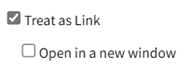
Treat As Link |
| When selected, the input becomes a clickable link. A checkbox selection forces the link to open in a new tab. | |
Text Box | Start Hidden | If selected, the field will be hidden when the modal first loads. | |
Show in View / Manage Entries | Selected by default; Deselect if the field is being used for data acquisition and you do not want it to be visible. | ||
Force Capitalization | Selecting “Force Capitalization” requires the information input to be capitalized. | ||
HTML Text Box | Start Hidden | If selected, the field will be hidden when the modal first loads. | |
Show in View / Manage Entries | Selected by default; Deselect if the field is being used for data acquisition and you do not want it to be visible. | ||
Checkbox | Start Hidden | If selected, the field will be hidden when the modal first loads. | |
Show in View / Manage Entries | Selected by default; Deselect if the field is being used for data acquisition and you do not want it to be visible. | ||
Checked By Default | If selected, the checkbox field created will be selected by default. | ||
Dropdown | Start Hidden | If selected, the field will be hidden when the modal first loads. | |
Show in View / Manage Entries | Selected by default; Deselect if the field is being used for data acquisition and you do not want it to be visible. | ||
Add Blank |
Select the plus sign icon to add additional entries. Textboxes must be saved individually through the disc icon or by the clickable “Save All” link. | ||
Add "Other" Option | If selected, “Other” will be included as a checkbox that when selected, opens a textbox for data input. | ||
Multiple | If selected, allows a user to pick more than one item from the dropdown menu. | ||
Options |
Select the plus sign icon to add additional entries. Textboxes must be saved individually through the disc icon or by the clickable “Save All” link. | ||
Radios | Start Hidden | If selected, the field will be hidden when the modal first loads. | |
Show in View / Manage Entries | Selected by default; Deselect if the field is being used for data acquisition and you do not want it to be visible. | ||
Options |
Select the plus sign icon to add additional entries. Textboxes must be saved individually through the disc icon or by the clickable “Save All” link. | ||
Date | Start Hidden | If selected, the field will be hidden when the modal first loads. | |
Show in View / Manage Entries | Selected by default; Deselect if the field is being used for data acquisition and you do not want it to be visible. | ||
Date / Time | Start Hidden | If selected, the field will be hidden when the modal first loads. | |
Show in View / Manage Entries | Selected by default; Deselect if the field is being used for data acquisition and you do not want it to be visible. | ||
File Upload | Start Hidden | If selected, the field will be hidden when the modal first loads. | |
Show in View / Manage Entries | Selected by default; Deselect if the field is being used for data acquisition and you do not want it to be visible. | ||
Max File Size | If left blank, the maximum upload file size is 500 MB. | ||
Allowed Extensions | Any extension | Allow anything to be uploaded. | |
Images | .jpg, .jpeg, .png, .gif, .bmp, .svg | ||
Documents | .doc, .docx, .odt, .pdf | ||
MS Word Document | .doc, .docx | ||
Spreadsheets | .xls, .xlsx, .csv | ||
MS Excel Spreadsheet | .xls, .xlsx | ||
MS Powerpoint Presentation | .ppt, .pptx | ||
Custom | Allows the form creator to specify what can be uploaded | ||
Allow Multiple Files | If selected, multiple files can be uploaded. | ||
Mandatory | If selected, a file upload will be required. | ||
Image | Start Hidden | If selected, the field will be hidden when the modal first loads. | |
Show in View / Manage Entries | Selected by default; Deselect if the field is being used for data acquisition and you do not want it to be visible. | ||
Max File Size | If left blank, the maximum upload file size is 500 MB. | ||
Allow Multiple Files | If selected, multiple images can be uploaded. | ||
Mandatory | If selected, an image will be required. | ||
Password | Start Hidden | If selected, the field will be hidden when the modal first loads. | |
Show in View / Manage Entries | Selected by default; Deselect if the field is being used for data acquisition and you do not want it to be visible. | ||
Signature Field | Start Hidden | If selected, the field will be hidden when the modal first loads. | |
Require 2FA | 2FA stands for two factor authorization. If selected, KAStrack will require a second method of authorization. | ||
All field types include a checkbox option to "Include on Form" that is selected by default. | |||



The following information can also be used when creating a form field.
Form Field Creation Inputs | |
Field | Explanation |
Default | Whatever is input as the default will automatically be input in the field. The default can be replaced by the individual adding the entry. |
Placeholder Text | The Placeholder Text textbox can be used to input greyed out text in a textbox that can be used as a hint in the field. It can be a maximum of 25 characters and will disappear when information is entered. |
Context Sensitive Help | Context Sensitive Help will be visible when the blue question mark icon is clicked. Utilize this to include additional information needed to aid in completion of the field. |
Field Validation | Field validation is the process of checking that the data entered into a form field meets specific rules or criteria before it is accepted or saved and is used to prevent typos, formatting errors, and missing information from entering the database. The Validation dropdown menu allows a user to select between Optional and Mandatory validation with specific formatting requirements, or a Custom Regular Expression. Selecting Mandatory from the dropdown menu requires that there is content in the field and that it fits a specific format. |
Validation Help | Validation help (similar to context sensitive help) allows for a customized message to explain what/how something needs to be entered for field validation. |
CSS is a standardized system used to determine how web pages look. CSS classes are groupings of various styles (e.g. border, font color and size), and can be defined in KAStrack forms with whatever styles you like. When you assign a CSS Class to a form field, the field inherits all the styling associated with that class. | |
Formatting Fields
A formatting field refers to a field or placeholder in a form, database, or document template. Formatting fields apply style, structure, or output rules to data, controlling how data is displayed, structured, and presented rather than what the data actually is. When a formatting field is used in a database, it is defining the visual output.
Withing KAStrack’s Forms Module, there are four formatting fields: Start Section, End Section, Tabs Start, Tabs End.
Formatting Fields Explanations | |
Field | Explanation |
Section Start | The Section Start formatting field is a control used in a database to signal the beginning of a new logical or visual section. It groups related fields on the same page and adds structure. |
If the start hidden checkbox is selected, the section formatting will be hidden when the field first loads. Note: If you select the start hidden checkbox, you will not be able to use a display CSS style for a section. | |
Formatting options for the new section include: border, border radius, padding, margin, background color, background image URL, background image position, background image size, background image repeat, font, text color, and roation. | |
Clicking “Show/hide advanced” opens a CSS Styling textbox. Note: All CSS styles must be valid CSS Styles. | |
All Section Start Fields must have a corresponding Section End Field. | |
Section End | The Section End Formatting Field marks the end of a formatted section that started with a Section Start formatting field. It communicates to the system “Stop applying the formatting or logic that began at the Section Start.” |
All Section End Fields must be used with a corresponding Section Start Field. | |
Tab Start | A tab start formatting field indicates the beginning of a new tab container or page in a multi-section form or document. Tab start creates separate pages or panels within a single form and improves navigation and organization. When you add a tab start field, it creates a new tab header and defines where the content of that tab begins. When another tab start field is used, a new tab is created by the system. |
All Tab Start Fields must have a corresponding Tab End field. Between the two, you are required to have a section that contains fields. | |
Tab End | A Tab End formatting field indicates the end of the active tab container that began with a Tab Start formatting field. |
All Tab Start Fields must have a corresponding Tab End field. Between the two, you are required to have a section that contains fields. | |
Utility Fields
A utility field is a hidden, system-level field that performs a technical or aesthetic function such as spacing, visibility control, conditional logic, calculations, or layout consistency, but does not represent a data element. Think of it as a helper field that manages how information looks or functions, not what it is.
Utility Field Explanations Table | |||
Field Type | Meaning / Purpose | How It Works | Field Creation Notes |
Information | Displays non-editable text, notes, or instructions to guide the user | Does not store data; it’s purely for communication or context within a form | Add descriptive text or HTML formatting |
Not linked to a database column | |||
Excluded from exports | |||
Can include hyperlinks or help icons | |||
Calculated | Automatically computes a value based on formulas or other field inputs | Performs calculations dynamically when the form loads or data changes | Define a formula |
Ensure source field exist and have proper data types | |||
Set decimal precision or rounding rules | |||
Can be updates automatically or when saved | |||
Sequential Number | Generates a unique, automatically incrementing number | Each new record triggers a sequence increment | Define state number and increment step |
Option to include prefixes (e.g. INV-01) | |||
Ensures prevention of duplicates | |||
Read-only to users | |||
Hidden Field | Stores data that is not visible to the user but is used by the system or workflows | Data may be filled automatically by logic, user ID, timestamp, or lookup. | Hidden from the user interface |
Used for internal references | |||
Ensures security | |||
Read Only | Displays data that the user can see but not change | Pulls values from the database or calculated results byut locks editing | Mark as non-editable |
Useful for summary or verification data | |||
Can still be exported | |||
Mail Merge | Acts as a placeholder in document templates that pulls live data into generated files | Replaces tags with actual field values during document generation | Must match database field names |
Verify formatting (dates, currency, capitalization) | |||
Used in templates for Word, pDF, or HTML | |||
Ensures privacy when merging client data | |||
Copy Previous Entry | Automatically fills a field with the value entered in the previous record | When creating a new record, the system retrieves the last entered value for that field | Choose which fields allow copying |
Ensure users can overwrite if needed | |||
Often used for reoccurring data | |||
Improves speed and data consistency | |||