
Manage Form Entries Page
The Manage Entries Page is utilized to add, edit, import, and export form entries. Bulk edits can be enabled on this page for efficiency by selecting the Enable Bulk Edit Mode checkbox below the filter.
You can access a form's Manage Entries Page by opening the Forms Module Home Page and clicking the three-dot icon to the right of a form name. Selecting Manage Entries from the Forms Table Context Menu will open the specified form's Manage Entries Page.
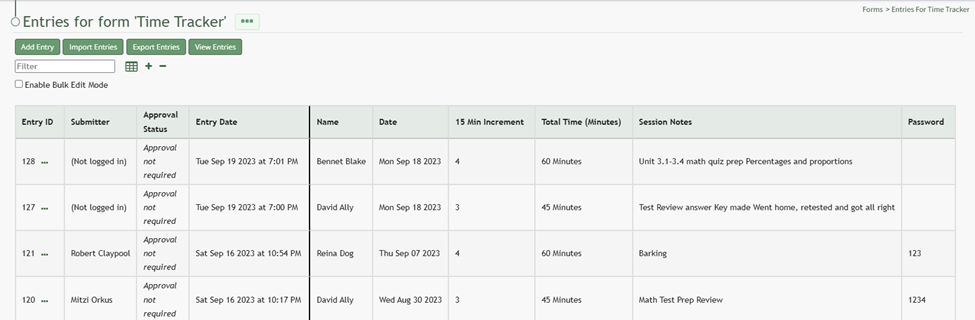
are three icons on the Manage Entries Page. Each icon is explained in the table below.
Manage Entries Page Icon Explanations Table | |
Icon | Explanation |
| The spreadsheet icon converts the table into a datatables table format. |
| The plus sign icon expands all form columns, showing all information collected by the form that might have be truncated because of space limitations. Individual entry rows can expand / collapse by selecting the clickable Less/More links in a cell. |
| The minus sign collapses all form columns, reverting back to truncated formatting. Individual entry rows can expand / collapse by selecting the clickable Less/More links in a cell. |


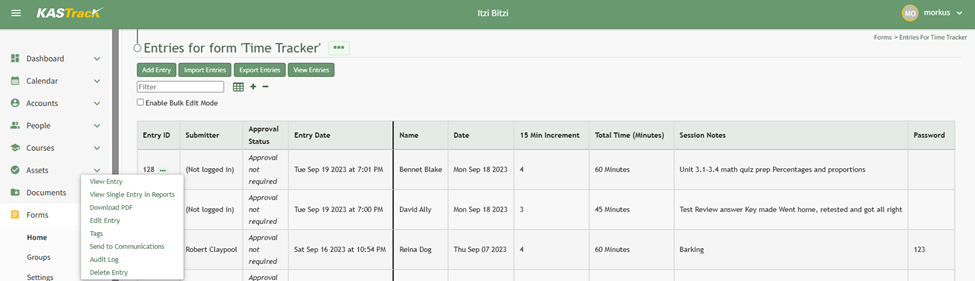
The three-dot icon to the right of the page header opens the Manage Entries Page Context Menu. This options on the context menu are explained in the table below.
| |
|
|
| |
|
|
|
|
|
|
|
|
|
|
|
|
|
|
|
|
| |
Options | Explanation |
View Entry | Selecting “View Entry” from the Forms Entries Table context menu will open the View Forms Entry Modal, showing all of the form field inputs for a specific entry. You can select the “Edit” button from this modal to open the Edit Database Modal and make any desired changes. |
View Single Entry in Reports | Selecting “View Single Entry In Reports” from the Form Entries Table context menu will open the single entry in the Reports Module with a table listing all fields and the inputs associated with the specific entry. |
Download PDF | Selecting “Download PDF” from the context menu will download the PDF that have been associated with the form. How To: Download a PDF Form{{@393}} |
Edit Entry | Selecting “Edit Entry” from the Forms Entries Table context menu will open the Edit Form Entry Modal where an individual can edit any entry inputs. How To: Edit a Form Entry{{@395}} |
Tags | Selecting “Tags” from the Forms Entries Table context menu will open the Forms Entry Tags Modal where an individual can add open, permissive, and restrictive tags to the forms entry. How To: Create a New Tag from an Entity in Another Module{{@81}} |
Send to Communications | Selecting “Send to Communications” from the Forms Entries Table context menu will open the Send Communications Page in the Communications Module. The form entry will be attached to a communications email with options to store the entry in documents, require acknowledgement, and require acknowledgement at Login. |
Audit Log | Selecting “Audit Log” from the Forms Entries Table context menu will open the read only Audit Log that shows the date and time a user completed an action in |
Delete Entry | Selecting “Delete Entry” from the Forms Entries Table context menu will open the Delete Forms Entry Confirmation Modal that states, “Are you sure you want to delete this Form Entry?” How To: Delete a Form Entry{{@390}} |
Notes Regarding the Downloadable Template for Uploading CSV Files
The first row of the CSV file is for each of the form fields. If you download a CSV Template from the Upload CSV Modal, two additional column headers will show that are not form fields: Entry ID and Modify Existing Entry.
If you are importing form entries and no entries have been added to the form yet, leave these columns blank in your upload.
If form entries already exist in the database, the Entry ID column will contain the unique system generated ID for each pre-existing database entry. Leave this column blank if the row is to be imported as a new entry. The second column, Modify Existing Entry, should have a “Y” input if the existing entry is being modified and an “N” input if it has not been modified. Leave this column blank if the entry is new.