
Database Rules Tab
Selecting “Rules” on a database context menu opens the Rules for database (DatabaseName) Page on the Rules Tab which shows the Rules Table. New rules can be added to the database from this tab.
Selecting “Rules” from the Databases Table context menu will open a form’s Rules Tab that contains the Rules Table. The Rules Table shows the conditions, actions, and status of a rule. Rules can be filtered for efficient access. The Rules Tab is where new rules can be added to your Database.
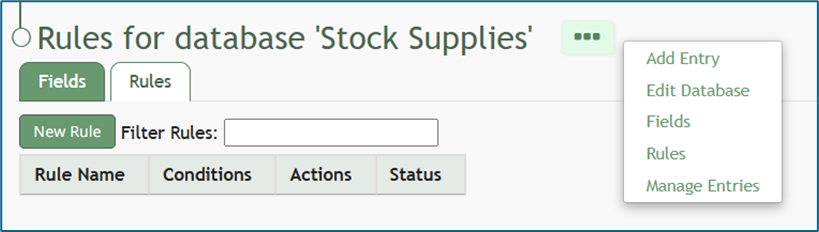
Fields / Rules Page Context Menu Option Explanation | |
Option | Explanation |
Add Entry | Selecting “Add Entry” on the context menu opens a New Database Entry Modal. The modal that appears for a new database entry has already been customized for that specific database and will vary significantly based on its purpose and design. WIKI LINK HOW TO: ADD A DATABASE ENTRY |
Edit Database | Selecting “Edit Database” on the context menu open the Edit Database Modal, allowing an individual to edit the specific permissions established when the database was created. WIKI LINK: HOW TO EDIT A DATABASE |
Field | Selecting “Fields” on the context menu opens the Fields for database (DatabaseName) Page on the Fields Tab which shows the Fields Table. New fields can be added to the database from this tab. WIKI LINK HOW TO: ADD A DATABASE FIELD |
Rules | Selecting “Rules” on the context menu opens the Rules for database (DatabaseName) Page on the Rules Tab which shows the Rules Table. New rules can be added to the database from this tab. WIKI LINK HOW TO: ADD A DATABASE RULE |
Manage Entries | Selecting “Manage Entries” on the context menu opens the Entries for Database (DatabaseName) Page and the Database Entries Table. Entries can be added, imported, and exported on this page. Bulk edits can also be enabled for efficiency.WIKI LINK HOW TO: ADD A DATABASE ENTRY WIKI LINK HOW TO: IMPORT DATABASE ENTRIES WIKI LINK HOW TO: EXPORT DATABASE ENTRIES |
In a database, fields are the columns where individual pieces of data are stored. Database Rules define how each field behaves – the type of data it can hold, what is and is not allowed, as well as how it interacts with other fields.
Within KAStrack, rules are required to have a Rule Name and Status (Active or Inactive). Conditions and Actions are optional fields in the New Database Rule Modal. Multiple conditions and / or actions as well as no conditions and / or actions can be used.
Rules Conditions
Conditions are what make field rules both powerful and flexible. They determine when, how, or if a rule applies. Conditions are what make field rules dynamic, allowing KAStrack to react to what a user enters or to what is stored in other fields.
A condition is a logical statement that must be true in order for a field rule to activate. (You can think of it as “If X happens, then do Y.” When conditions are applied, rules will only be utilized if certain criteria are met.
A Conditional Rule always has three parts, explained in the Structure of a Conditional Rule Table.
The Structure of a Conditional Rule | ||
Part | Description | Example |
Trigger | What the rule watches | Status |
Condition | What must be true | = “Pending” |
Action / Result | What happens if the condition is true | “Make Compliance Data field required” |
Within KAStrack, a condition can be triggered by fields, the system, or steps.
| |||
|
|
|
|
Form Fields | General | Is Equal To | |
Is Not Equal To | |||
Matches Regular Expression | |||
Does Not Match Regular Expression | |||
Is Blank | |||
Is Not Blank | |||
Is Updated | |||
Numeric | < | ||
<= | |||
> | |||
>= | |||
System | Current Time | Is Before | |
Is After | |||
User / On Behalf of User | Is a Member of Certification Role | ||
Is not a member of Certification Role | |||
Is valid in Certification Role | |||
Is not valid in Certification Role | |||
Has access level | |||
Does not have access level | |||
Is logged in | |||
Is not logged in | |||
Is supervised by (direct) | |||
Is supervised by (all) | |||
User/ On Behalf of User: Username User/ On Behalf of User: Full Name | General | Is Equal To | |
Is Not Equal To | |||
Matches Regular Expression | |||
Does Not Match Regular Expression | |||
Is Blank | |||
Is Not Blank | |||
Is Updated | |||
Numeric | < | ||
<= | |||
> | |||
>= | |||
Logged In User | Is a Member of Certification Role | ||
Is not a member of Certification Role | |||
Is valid in Certification Role | |||
Is not valid in Certification Role | |||
Has access level | |||
Does not have access level | |||
Is logged in | |||
Is not logged in | |||
Is supervised by (direct) | |||
Is supervised by (all) | |||
Logged in User: Username Logged In User: Full Name | General | Is Equal To | |
Is Not Equal To | |||
Matches Regular Expression | |||
Does Not Match Regular Expression | |||
Is Blank | |||
Is Not Blank | |||
Is Updated | |||
Numeric | < | ||
<= | |||
> | |||
>= | |||
Steps | No Step | Is the Current Step | |
Is Not the Current Step | |||
Submitted | Is the Current Step | ||
Is Not the Current Step | |||
There are different categories of Form Rule Actions.
Forms Rules Actions | |
Category | Available Rule Actions |
Field Management | Show / Hide Fields, Change Validation of Fields, Change the Value of Fields, Lock / Unlock Fields, Increment a Sequential Number Field, Add / Remove CSS Class, Configure a signature field |
Workflow | Show Save and Next button, Do Not Allow Submission |
Other | Use An Alternative Entry PDF, Use An Alternate Filename For Entry PDF |