Communications Module
- Communications: Introduction
- Communications: Module Pages
- Send Communications Page
- QR Codes Page
- Supervisor Page
- Settings Page: Module Settings Tab
- Settings Page: Notifications Templates Tab
- Settings Page: Communications Template Tab
- Settings Page: Account Setting Tab
- Settings Page: Alert Email Templates Tab
- Settings Page: Module Levels Tab
- Communications: Supplemental Resources
Communications: Introduction
Communications Module Summary
The Communications Module allows KAStrack users to send communications to other users through the system, logging all messages sent and received. In this module, templates for notifications, communication, and email alerts are created, account settings established, and permissions for module levels designated.
Communications: Module Pages
Send Communications Page
The Send Communications Page of the Communications Module allows individuals with the appropriate module access level (administrators and supervisors by default) to send communications within KAStrack.
All communications sent via KAStrack are logged.
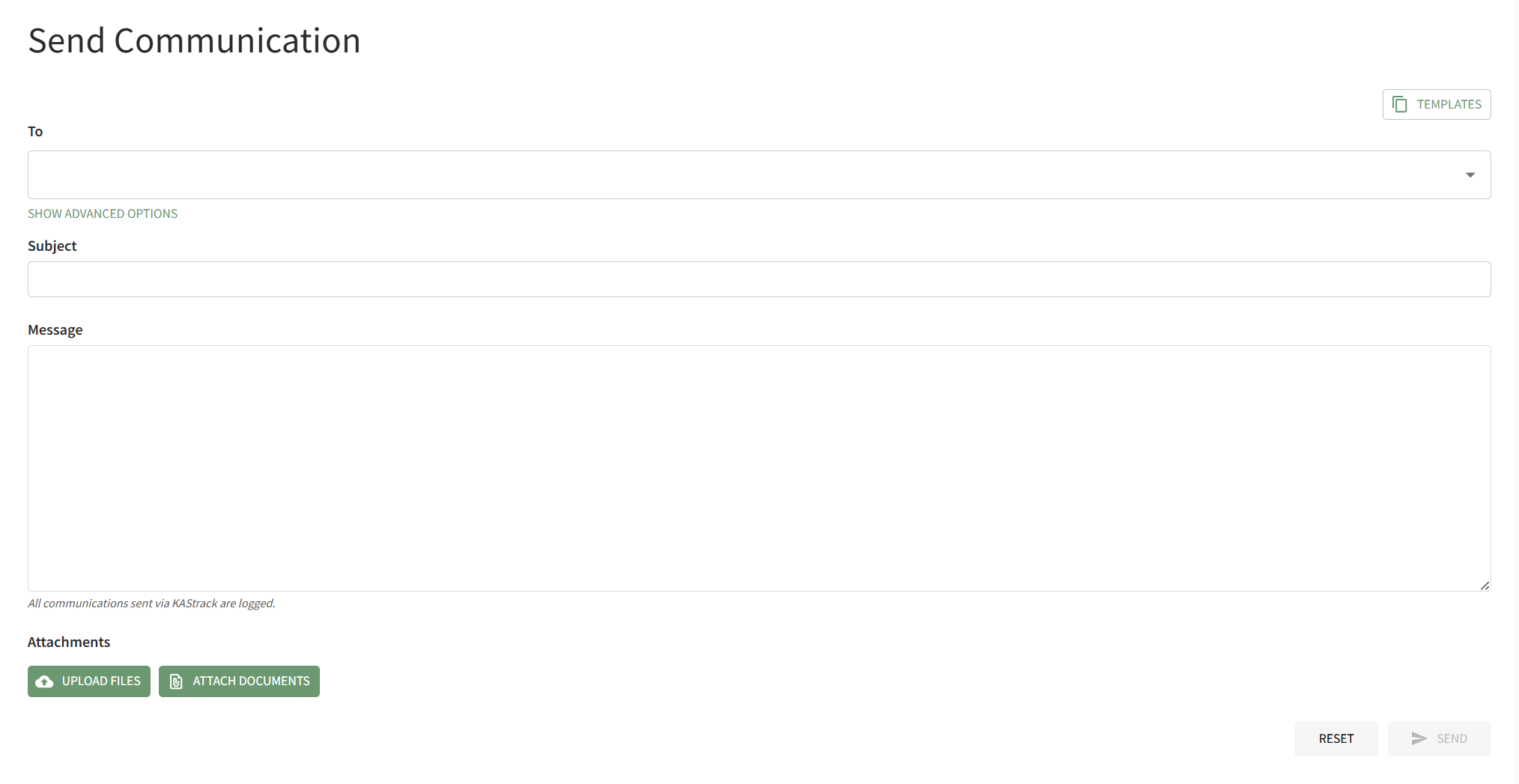
To send a message in KAStrack from the Communications Page, select the individuals, Certification Roles, or Access Levels who are to receive the message being sent, inputting a subject line and message. Communications can have attachments from your personal device uploaded to them or have files from the Documents Module attached.
How To: Send an Email in KAStrack
How To: Upload a File to an Email
How To: Attach a Documents Module File To an Email
How To: Use a Communications Template when Sending an Email
If a Communication Template is applied to a message on the Send Communications Page, the template will override any information that was manually entered in the subject line and message field.
How To: Create New Communication Templates
To create a new communication template, go to the Communication Templates Tab on the Settings Page of the Communications Module.

Select the “New Communication Template” button opening the New Template Modal.

Input the Title for the Template.
Select Active / Inactive from the dropdown menu to indicate if the template is available for use.
Both individual people and certification roles can be selected as desired recipients via dropdown menu in the “Send To” line.
Include the subject line for communications, as well as a message.
An attachment can be uploaded from your personal device to be included in the template, or you have the option to select one or more files from KAStrack’s Document Module.
KAStrack documents that are tagged may limit visibility of this template. Specifically, if a template contains a tagged document you cannot see, you will be unable to see the template when sending a communication. Individuals with access to a Document that has visibility restrictions for others via Tags cannot use Send Communication to send that tagged Document to users that lack the authorization to see it.
Select “Save” and the New Communications Template will show in the Communications Template Table on the Settings Page.
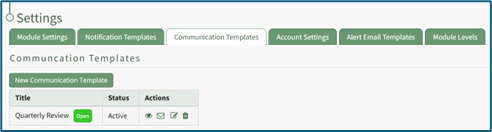
The template can now be applied as desired when sending communications in the system on the Send Communications Page. You can also click the closed envelope symbol in the Communication Templates table to go to the Send Communications page and pre-fill the chosen template.
Advanced Options
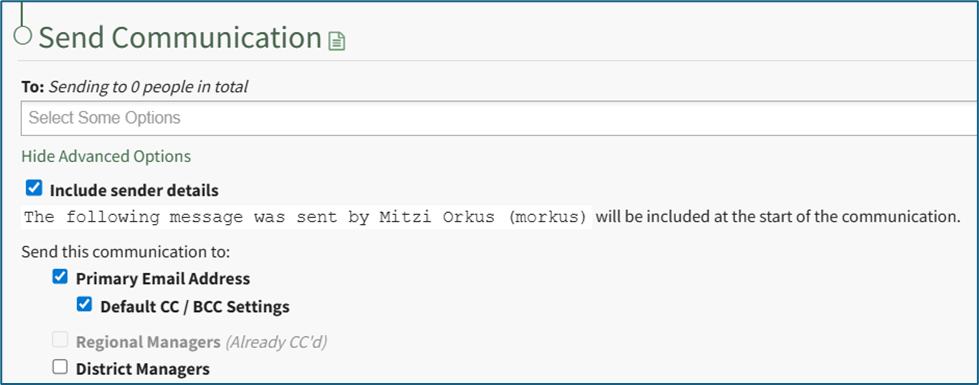
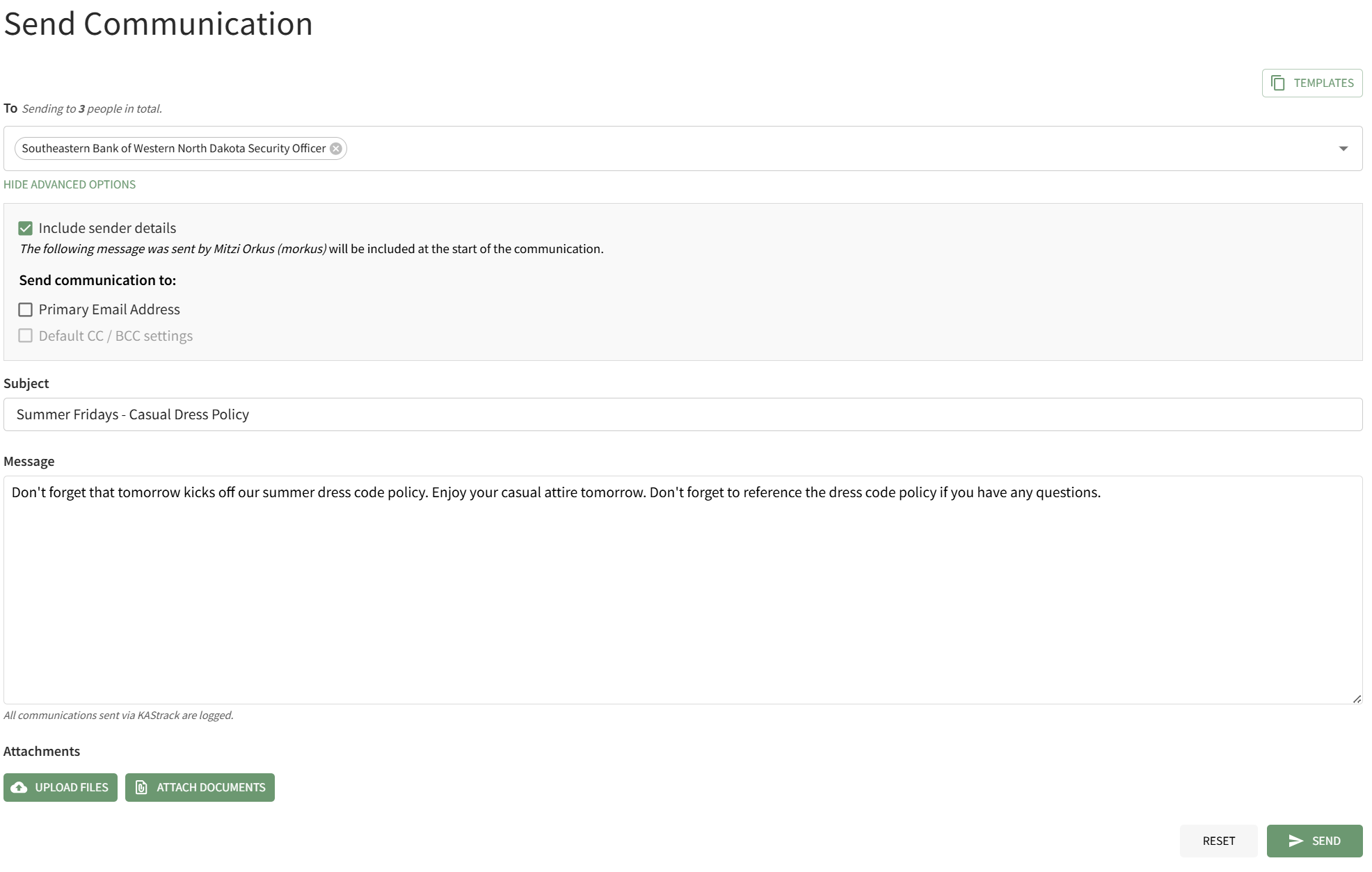
Clicking “Show Advanced Options” beneath the To field expands the Send Communication Page showing advanced options for sending messages.
By default, Advanced Options are only available for Admin Access Levels.
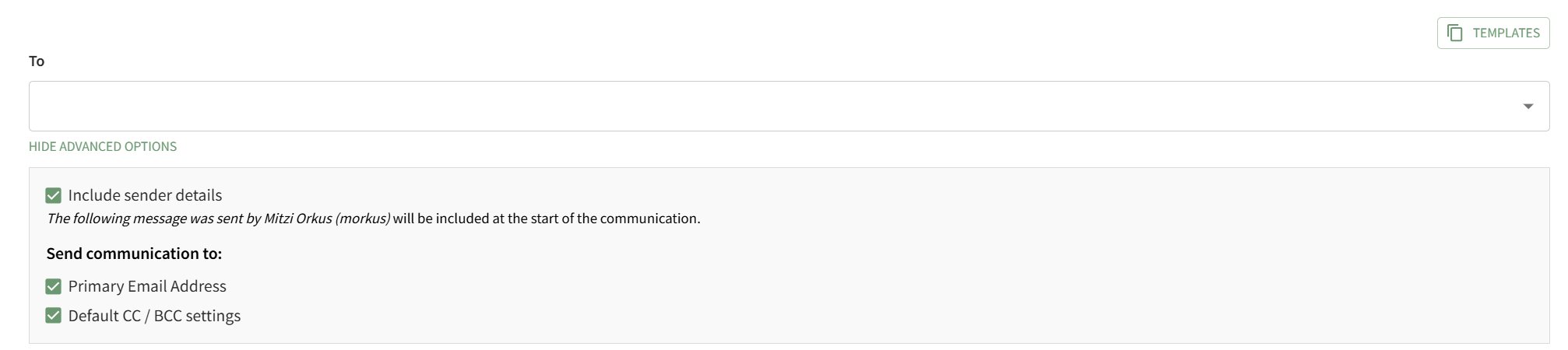
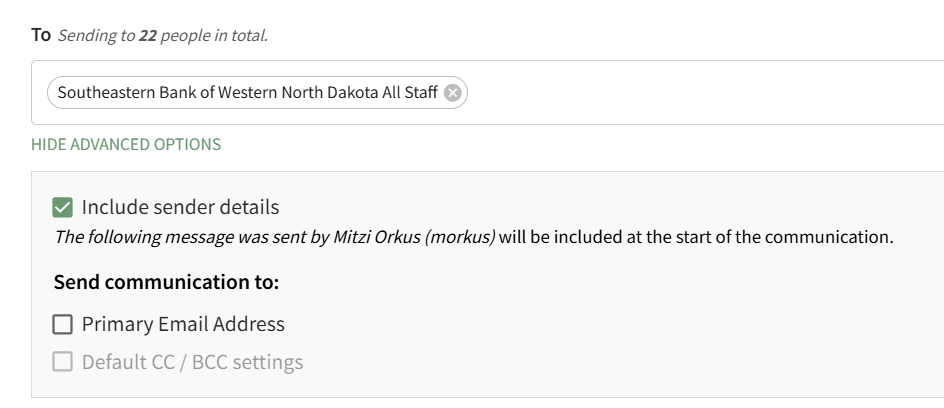
Selecting the “Include sender details” checkbox will include the following message at the start of the communication, “The following message was sent by FIRST NAME LAST NAME (Username).”
Selecting the “Primary Email Address” checkbox will send the communication to the primary email address of the individuals or certification roles listed in the “To” line. The Primary Email Address refers to the system account field “Email” on users’ accounts.
Selecting the “Default CC / BCC Settings” checkbox will send the communication per the customized specifications made on the Module Settings Tab of the Settings Page in the Communications Module.
Any other additional account fields set as type “Email” will show below the “Default CC/BCC Settings” checkbox. If the additional account information field is already selected through the CC/BCC Settings, it will show in gray and state “(Already CC’d)”.

Any additional account information fields not already included through your customized settings will show with a checkbox and can be added if desired.
In order to customize CC/BCC Settings, review the section on the Module Settings Tab.
How To: Set Up Additional Account Fields for Email Settings
To utilize the CC and BCC Email Settings on the Module Settings Tab of the Settings Page in the Communications Module, you must first set up additional user account information fields.
To set up additional user account information fields with email settings, go to the Account Fields Tab of the Site Settings Module.

Select “Add a Field” beneath the Custom / Additional User Account Information Fields opening the Add Field Modal.

Enter a Label for the new field, and select “email” as the type of field.
The checkboxes below allow for customization. Select “Allow multiple values” if there could be multiple emails associated with this field for an account. Select “Required” if you would like to require that this field be filled out for each account. Selecting the “Sensitive field” checkbox will tell KAStrack not to show this information when the field is being included in a report or form entry.
Select the permissions to be granted for each Accounts Module Level for this field, communicating if each Module Level can view their own/others and edit their own/others.
Under Accounts Module Level in the permissions grid, “Logged out user” refers to how fields will be displayed to users creating their account via a Registration Profile Link. To allow users to fill in information for the chosen field, ensure that the Edit Own permission is enabled for that field for “Logged out user”.
Select “Save” to create the new account information field.

The newly created email account fields will now show on the Account Info: (UserName) Page.
QR Codes Page
The QR Codes Page in the Communications Module allows a user to create and manage custom QR codes with specified URL destinations.

How To: Download Multiple QR Codes at Once
How To: Download QR Code Hits Data as a CSV
All QR Codes created are listed in the QR Code Table. An explanation of the icons used on the QR Code Page is included in the table below.
QR Code Page Icons | |
Icon | Associated Action |
| Selecting the plus-sign icon to the right of the QR Code page header opens the New QR Code Modal. |
| Selecting the two page icon in the URL Column of the QR Code Table copies the QR Code's Destination URL Link. |
| Selecting the paper and pencil icon in the Actions Column of the QR Code Table opens the Edit QR Code Modal. |
| Selecting the trashcan icon in the Actions Column of the QR Code Table opens the QR Code Deletion Confirmation Modal. |


Individual QR codes can be viewed, copied, or downloaded as needed.
How To: View a QR Code
How To: Copy a QR Code
How To: Download an Individual QR Code
The record of the number of times a QR Code has been used can be reset whenever desired.
How To: Reset the Hit Count on a QR Code
Supervisor Page
The Supervisor Page of the Communications Module allows for the viewing and bulk editing of the Email Report and Email Alert Notifications Settings preferences for the users you directly supervise.

The page is divided into two tables, one for Email Reports and one for Email Alerts.
Selecting the checkbox in the first column of the title row of the Reports and Alerts Table will select all supervised users in that table. Selecting a user in one table automatically selects them in the other.
At the top of the page, you can filter users by username, first name, or last name. Begin typing in the Search field and the page will automatically filter to matching users. The dropdown to the right of the Search field allows you to filter by users who have Active or Inactive status for either Email Reports or Email Alerts. Leave the dropdown blank to show all users regardless of status.
The Account Settings Reports Table will list all users that you supervise. If the user is receiving a reports email, a check will show in the Active Column. If not, an X will show. The report sent for each module will be listed, or Do Not Receive will show if none are selected. The frequency email reports are received will show in the frequency column.
The Account Settings Alerts Table will list all account users that you supervise. If the user is receiving alert emails, a check will show in the Active Column. If not, an X will show. Each module will state if alerts are being sent in Real Time, Digested (sent between midnight and 4 a.m. Central Time (United States)daily), or set to Do Not Receive.
Once you have selected users, you can choose either of the Set Selected or Edit Selected buttons at the top of the page. Set Selected allows you to apply an existing Notification Template to the selected user(s). Choose a Notification Template from the dropdown menu, then select “Save” to apply the template to the selected user(s), or press “Cancel” to close the modal and go back to the Supervisors page.

Edit Selected allows you to change specific settings for the selected users. You can choose to update the users’ status for Reports / Alerts, which Reports they receive, their Report receipt frequency, and whether they should receive Email Alerts in Real Time, Digested, or not at all (Do Not Receive). After making any changes, select “Save” to apply the changes to the selected user(s), or press “Cancel” to close the modal and go back to the Supervisors page.


Settings Page: Module Settings Tab
The Module Settings Tab on the Settings Page of Communications Module allows a user to designate preferences for communications manually sent through the Send Communications Page of the module as well as for communications automatically sent from the system.

Email Settings
There are three checkboxes that allow for the customization of communications automatically sent from the system: Enable CC, Enable BCC, and Enable Catch Missing CC. The fourth checkbox, Enable Send Communication CC, pertains to the customization of manually sent communications.
In order to utilize some of these module settings features, you must set up additional account fields first.
How To: Set Up Additional Account Fields for Email Settings
To utilize the CC and BCC Email Settings on the Module Settings Tab of the Settings Page in the Communications Module, you must first set up additional user account information fields.
To set up additional user account information fields with email settings, go to the Account Fields Tab of the Site Settings Module.
Select “Add a Field” beneath the Custom / Additional User Account Information Fields opening the Add Field Modal.
Enter a Label for the new field, and select “email” as the type of field.
The checkboxes below allow for customization. Select “Allow multiple values” if there could be multiple emails associated with this field for an account. Select “Required” if you would like to require that this field be filled out for each account. Selecting the “Sensitive field” checkbox will tell KAStrack not to show this information when the field is being included in a report or form entry.
Select the permissions to be granted for each Accounts Module Level for this field, communicating if each Module Level can view their own/others and edit their own/others.
Under Accounts Module Level in the permissions grid, “Logged out user” refers to how fields will be displayed to users creating their account via a Registration Profile Link. To allow users to fill in information for the chosen field, ensure that the Edit Own permission is enabled for that field for “Logged out user”.
Select “Save” to create the new account information field.
The newly created email account fields will now show on the Account Info: (UserName) Page.
Traditionally, CC (carbon copy) and BCC (blind carbon copy) are ways of including additional recipients in an email besides the main person (or people) the email is addressed to.
Selecting “Enable CC” will CC included users for all communications automatically sent through the system and allows everyone on the email to see who was copied. An additional account email information field on the Account Info: (User Name) Page can be used to organize email addresses for individuals other than the primary email address on the account. Select the additional account information email field you would like CC’d from the dropdown menu shown when the Enable CC checkbox is selected.
Only one email account field can be selected via drop down menu.
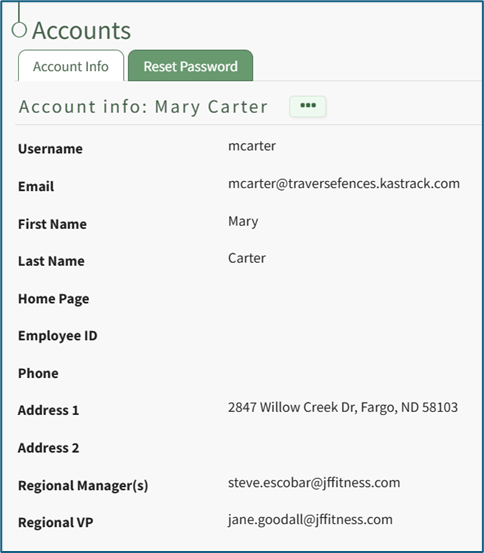
Selecting “Enable BCC” will BCC included users for all communications automatically sent through the system but does not allow the main recipients or CC’d recipients of the email to see who was copied. An additional account email information field on the Account Info: (User Name) Page can be used to organize email addresses for individual’s other than the primary email address on the account. Select the additional account information email field you would like BCC’d from the dropdown menu shown when the Enable BCC checkbox was selected.
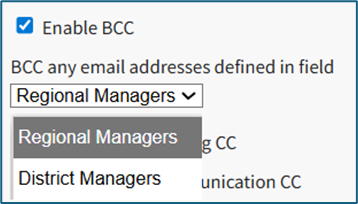
Only one email field can be selected via drop down menu.
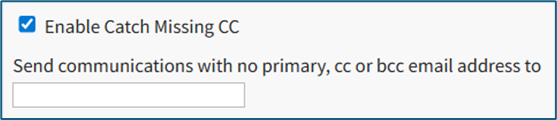
Select “Enable Catch Missing CC” and input an email address if you would like an email sent to an individual on behalf of a user whose primary email address field, as well as any CC and BCC email addresses (if present on their account), are all system-generated email addresses or blank. KAStrack has the capability to determine if an account user has input an email address of if a system-generated @[subdomain].katrack.com email address is being utilized.
Selecting “Enable Send Communication CC” applies to the customization of manually sent communications originating on the Send Communications Page in the Communications Module.
Only one email account field can be selected via drop down menu, but additional email account fields can be selected from the Send Communications Page.
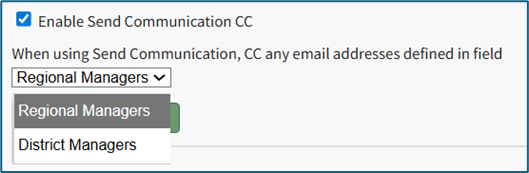
Users will still have the ability to customize their CC selection from the Send Communications Page. WIKI LINK ADVANCED OPTIONS (SEND COMMUNICATIONS PAGE)
System Settings

If the “Suspend all communications” checkbox is selected, only necessary messages will still be sent to users. (e.g. Direct Communications, Password resets, etc.).
Settings Page: Notifications Templates Tab
The Notification Templates Tab in the Communications Module houses the Default New User Template, which details the default designations for report and alert notifications that can be applied to all newly created user accounts. New user accounts manually created on the Create Tab of the Accounts Module will utilize the template specified via the dropdown menu to the right of “Default template to use for new accounts:”.

The preferred Notification Template applied to account being created via a Registration Profile Link can be specified in the Registration Profile design, when asked which notification template to apply.
How To: Create Registration Profiles (Site Settings Module)
To create a new registration profile, go to the Registration Tab in the Site Settings Module.

Click the plus icon next to the Registration Profiles header or select “Create” from the three dot (…) icon context menu. This will open the Create Registration Profile Page.
The fields used in a Registration Profile are optional. You are not required to make selections for all when generating a new profile.
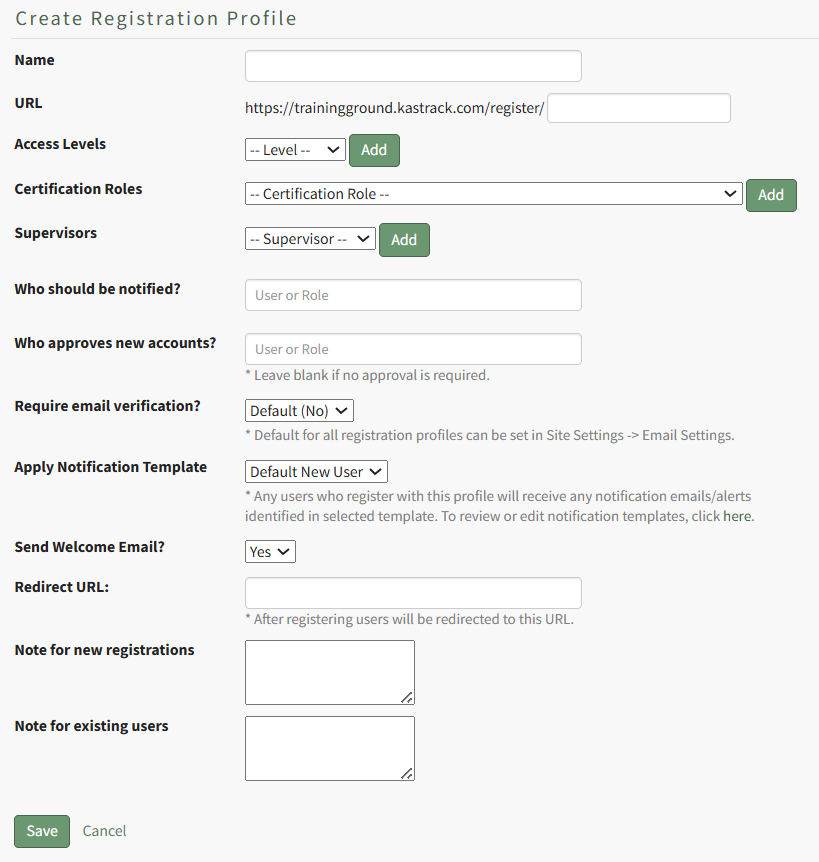
Input a name for the new registration profile, which will automatically fill in the URL link textbox.

Select any desired access level(s) for this registration profile from the dropdown menu list and click “Add”. Multiple Access Levels can be selected. The X icon to the left of the access level will remove the selection if it was made in error.
It is recommended to include at least one access level if this Registration Profile will be used to register new user accounts, as they must have an access level to see anything in KAStrack.

Select any desired Certification Role(s) for this registration profile from the dropdown menu list and click “Add”. Multiple Certification Roles can be selected. The X icon to the left of the Certification Roles will remove the selection if it was made in error.

Select any desired supervisor(s) that are to be assigned to the new accounts that register with this profile from the dropdown menu list and click “Add”. Multiple supervisors can be selected. The X icon to the left of the supervisor will remove the selection if it was made in error.

If desired, you can specify individual users and/or certification roles that are to receive notification of the new user account’s registration. When you type into the textbox, users and certification roles will show on a dropdown menu for selection. Multiple users and/or certification roles can be selected. The X icon to the left of the user / role will remove the selection if it was made in error.
If new registrations require approval, you can specify individual users and/or certification roles that are responsible for approving the new registrations. When you type into the textbox, users and certification roles will show on a dropdown menu for selection. Multiple users and/or certification roles can be selected. The X icon to the left of the user / role will remove the selection if it was made in error. Leave this field blank if no approval is required.
The default is set to not require email verification for new account generation, but you can select Yes or No from a dropdown menu. Users will then receive an email after registration asking them to verify their email address.
The default for all registration profiles can be set on the Email Settings Tab in the Site Settings Module, but the Registration Profile being created will override the default settings.
A default new user notification template is applied for all registration profiles.

Any users who register with this profile will receive notification emails/alerts that have been specified through the new user template. The Default New User Notification Template details are shown on the Notification Templates Tab on the Settings Page of the Communications Module. Clicking the word “here” will redirect the user to the Notification Template Tab where the Default New User Template can be edited or a new notification template can be created for your organization’s preferences.
How To: Edit New User Notification Templates
To edit new user notification templates, go to the Notification Templates Tab on the Settings Page of the Communications Module.
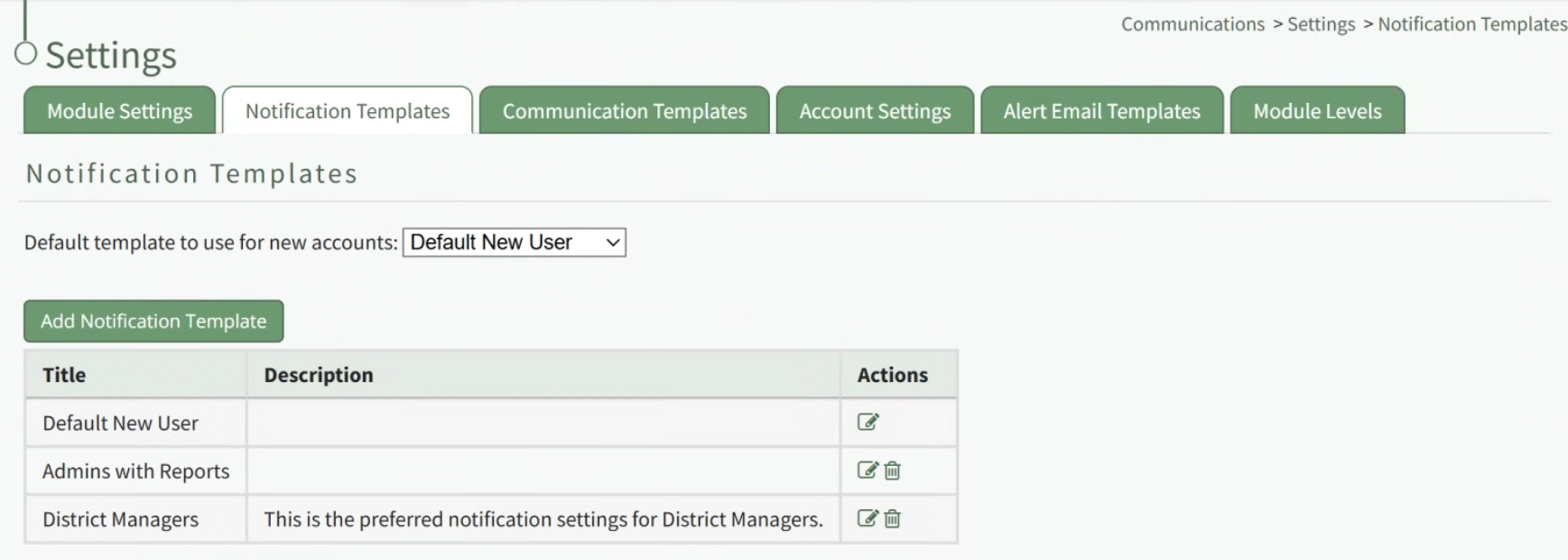
Existing templates will be shown in the Notification Template Table.
Select the edit icon in the action column of the template you wish to edit opening the Edit Notification Template Page.
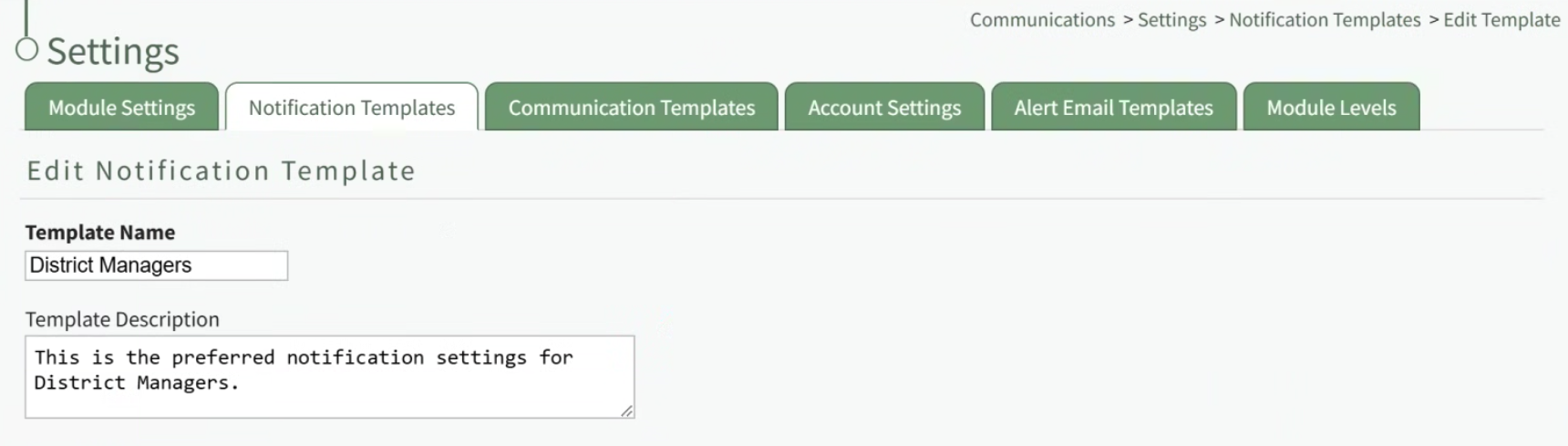
A notification template is comprised of two parts: Reports and Alerts.
Indicate the desired status for email report notifications: Not Active or Active.
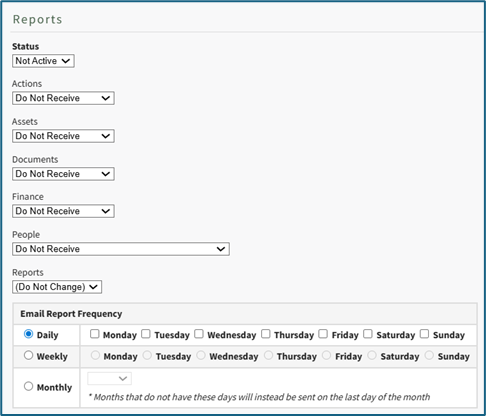
Alter the desired reports selected for each module or leave as “Do Not Receive”.
Email Report Frequency has three options: daily (or on specified days of the week), weekly (on the day of your choosing), or monthly (which requires the user to specify which numerical day of the month from a dropdown menu you wish to receive the report summary).
After setting template preferences for reports, scroll down to set template preferences for email alerts.
Alter email preferences as set by module through a dropdown menu with three options that designate when an email alert should be sent: “Real Time”, “Digest”, and “Do Not Receive”.

After making edits to your preferences for both Email Report and Email Alert Settings, select “Save”, returning you to the Notification Templates Tab on the Settings Page of the Communications Module.
The newly created notification template will now be shown on the Notification Template Table.
If you would like new user accounts that use this registration profile to receive a Welcome Email, select yes from the dropdown menu.
The default for all registration profiles can be set on the Email Settings Tab in the Site Settings Module, but the Registration Profile being created will override the default settings.
A redirect URL can be designated, so that any user registering with this profile will be redirected to the specified URL after registering.

Input a custom message for new registrations and a custom message for existing users if desired.
If an existing user logs in from a Registration Profile link, the access level(s), certification role(s), and supervisor(s) listed on the Registration Profile will be added to the user’s account. Any existing access levels, certification roles, and supervisors on their account are not removed.
Select “Cancel” at any time to return to the Registration Profile Tab in the Site Settings Module without saving the profile. Select the “Save” button and the new registration profile now shows on the Registration Tab in the Registration Profile Table.
Registration profiles can be enabled/disabled via a checkbox in the Registration Profile Table so that your organization has control of when this link is activated.
Email report notifications and email alert notifications can be customized by an individual on the Notifications Tab on the My Account Page in the Accounts Module. Prior to an individual’s customization selections, the default template selected in the Communications Module establishes the default settings.
The system-generated Default New User template can be edited.
How To: Edit New User Notification Templates
To edit new user notification templates, go to the Notification Templates Tab on the Settings Page of the Communications Module.
Existing templates will be shown in the Notification Template Table.
Select the edit icon in the action column of the template you wish to edit opening the Edit Notification Template Page.
A notification template is comprised of two parts: Reports and Alerts.
Indicate the desired status for email report notifications: Not Active or Active.
Alter the desired reports selected for each module or leave as “Do Not Receive”.
Email Report Frequency has three options: daily (or on specified days of the week), weekly (on the day of your choosing), or monthly (which requires the user to specify which numerical day of the month from a dropdown menu you wish to receive the report summary).
After setting template preferences for reports, scroll down to set template preferences for email alerts.
Alter email preferences as set by module through a dropdown menu with three options that designate when an email alert should be sent: “Real Time”, “Digest”, and “Do Not Receive”.
After making edits to your preferences for both Email Report and Email Alert Settings, select “Save”, returning you to the Notification Templates Tab on the Settings Page of the Communications Module.
The newly created notification template will now be shown on the Notification Template Table.
New Notification Templates can also be created.
How To: Create New Notification Templates
Note: A default new user Notification Template already exists in the system. This template can be edited for your preferences.
How To: Edit New User Notification Templates
To edit new user notification templates, go to the Notification Templates Tab on the Settings Page of the Communications Module.
Existing templates will be shown in the Notification Template Table.
Select the edit icon in the action column of the template you wish to edit opening the Edit Notification Template Page.
A notification template is comprised of two parts: Reports and Alerts.
Indicate the desired status for email report notifications: Not Active or Active.
Alter the desired reports selected for each module or leave as “Do Not Receive”.
Email Report Frequency has three options: daily (or on specified days of the week), weekly (on the day of your choosing), or monthly (which requires the user to specify which numerical day of the month from a dropdown menu you wish to receive the report summary).
After setting template preferences for reports, scroll down to set template preferences for email alerts.
Alter email preferences as set by module through a dropdown menu with three options that designate when an email alert should be sent: “Real Time”, “Digest”, and “Do Not Receive”.
After making edits to your preferences for both Email Report and Email Alert Settings, select “Save”, returning you to the Notification Templates Tab on the Settings Page of the Communications Module.
The newly created notification template will now be shown on the Notification Template Table.
To create a new notification template, go to the Notification Templates Tab on the Settings Page of the Communications Module.
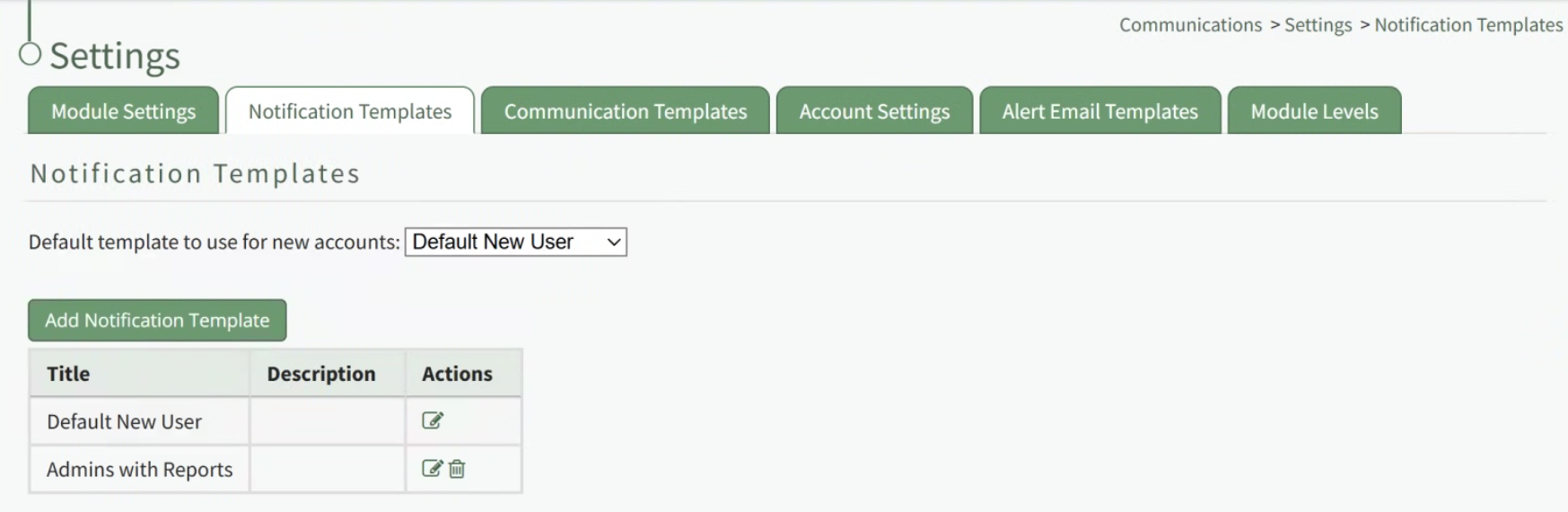
Select the “New Notification Template” button, opening the Edit Notification Template Page.
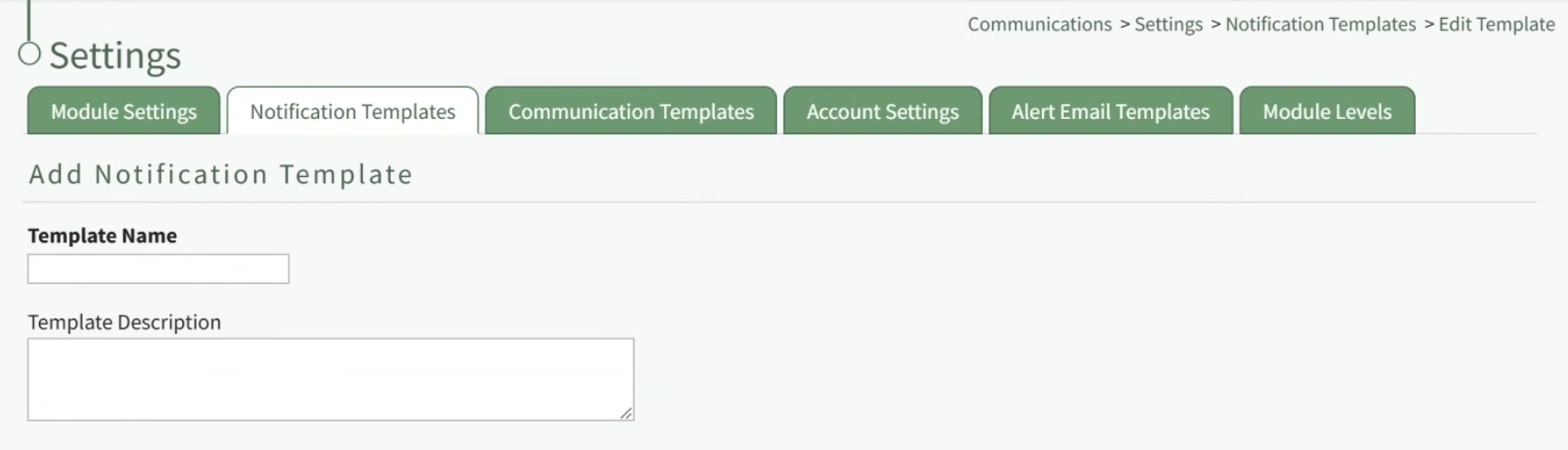
Input a name for the new Notification Template as well as a description.
A notification template is comprised of two parts: Reports and Alerts.
Indicate the desired status for email report notifications: Not Active or Active.
KAStrack generates and sends reports for the following modules: Actions, Assets, Documents, Finances, and People, and Reports.
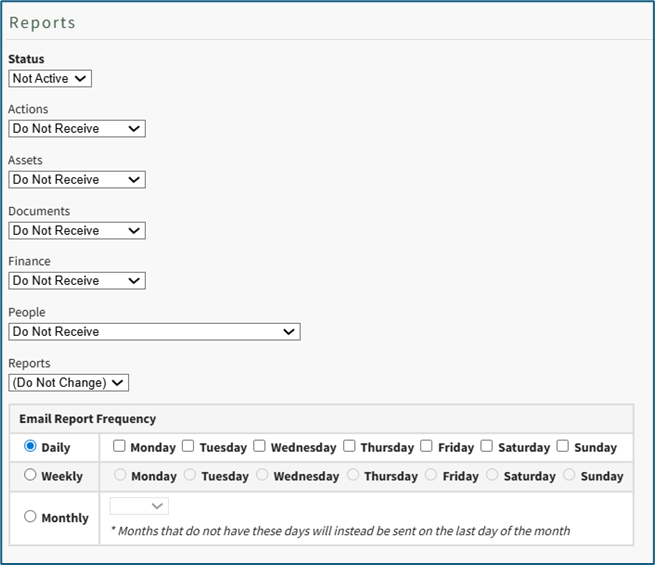
Alter the desired reports selected for each module or leave as “Do Not Receive”.
Daily email report notifications can be sent everyday of the week, or on specific days. Select the appropriate checkboxes to indicate your preference.
Selecting a weekly email report notification requires you to indicate which day of the week you prefer the report summary email to be sent.
Selecting a monthly frequency requires the user to specify which numerical day of the month from a dropdown menu you wish to receive the report summary. The days that are not included in every month (29, 30, 31) have an asterisk next to them. If the current month does not have that particular date, the system will send the report on the final day of the month.
After setting template preferences for reports, scroll down to set template preferences for email alerts.
KAStrack sends email alerts for the following modules: Accounts, Actions, Assets, Dispatch, Documents, Finance, Forms, Meetings, and People. Each module has a dropdown menu with three options that designate when an email alert is sent: “Real Time”, “Digest”, and “Do Not Receive”.

Real Time is the default setting that sends email alerts in real time.
Digest is KAStrack’s delayed timing feature. Selecting “Digest” will summarize all alerts with this designation to be sent daily between midnight and 4 a.m. Central Time (United States). As noted in KAStrack, alert digests are not applicable to all alerts.
Whether or not an alert is digestible can be customized on the Alert Email Templates Tab of the Communications Module.
Do Not Receive designates that the user does not wish to receive email alerts about that specific module.
Communications sent from users are always sent in real time
After selecting your preferences for both Email Report and Email Alert Settings, select “Save”, returning you to the Notification Templates Tab on the Settings Page of the Communications Module.
The newly created notification template will now be shown on the Notification Template Table.
Email Report Settings Explanation
KAStrack generates and sends reports for the following modules: Actions, Assets, Documents, Finances, and People, and Reports.
Regular Reports Available via Email Communication | |
Module | Reports Available |
Actions | Executive Summary |
Assets | Executive Summary, Detailed Report |
Documents | Executive Summary |
Finance | My Budgets, Executive Summary |
People | Executive Summary, Detailed Report (All Users), Detailed Report (Supervised Users), Detailed Report (All Users Group By Supervisor) |
Report | System and Custom Reports from the reports module. A complete list of the reports available to an individual can be viewed on their reports module homepage. |
Daily email report notifications can be sent every day of the week, or on specific days. Select the appropriate checkboxes to indicate your preference. Selecting a weekly email report notification requires you to indicate which day of the week you prefer the report summary email to be sent. Selecting a monthly frequency requires the user to specify which numerical day of the month from a dropdown menu you wish to receive the report summary. The days that are not included in every month (29, 30, 31) have an asterisk next to them. If the current month does not have that particular date, the system will send the report on the final day of the month.
Email Alert Settings Explanation
KAStrack sends email alerts for the following modules: Accounts, Actions, Assets, Dispatch, Documents, Finance, Forms, Meetings, and People. Each module has a dropdown menu with three options that designate when an email alert is sent: “Real Time”, “Digest”, and “Do Not Receive”.
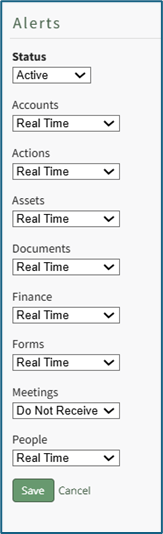
Real Time is the default setting that sends email alerts in real time. Digest is KAStrack’s delayed timing feature. Selecting “Digest” will summarize all alerts with this designation to be sent daily between midnight and 4 a.m. Central Time (United States). As noted in KAStrack, alert digests are not applicable to all alerts.
Whether or not an alert is digestible can be customized on the Alert Email Templates Tab of the Communications Module.
Do Not Receive designates that the user does not wish to receive email alerts about that specific module.
Communications sent from users are always sent in real time.
Settings Page: Communications Template Tab
The Communication Templates Tab on the Settings Page of the Communications Module is where new communication templates can be created and managed.
There are no system default Communication Templates.

Communication templates are used to design the prefilling of fields and preloading of attachments for use when sending messages in the system from the Send Communications Page.
How To: Create New Communication Templates
To create a new communication template, go to the Communication Templates Tab on the Settings Page of the Communications Module.
Select the “New Communication Template” button opening the New Template Modal.
Input the Title for the Template.
Select Active / Inactive from the dropdown menu to indicate if the template is available for use.
Both individual people and certification roles can be selected as desired recipients via dropdown menu in the “Send To” line.
Include the subject line for communications, as well as a message.
An attachment can be uploaded from your personal device to be included in the template, or you have the option to select one or more files from KAStrack’s Document Module.
KAStrack documents that are tagged may limit visibility of this template. Specifically, if a template contains a tagged document you cannot see, you will be unable to see the template when sending a communication. Individuals with access to a Document that has visibility restrictions for others via Tags cannot use Send Communication to send that tagged Document to users that lack the authorization to see it.
Select “Save” and the New Communications Template will show in the Communications Template Table on the Settings Page.
The template can now be applied as desired when sending communications in the system on the Send Communications Page. You can also click the closed envelope symbol in the Communication Templates table to go to the Send Communications page and pre-fill the chosen template.
Settings Page: Account Setting Tab
The Account Settings Tab on the Settings Page of the Communications Module allows for the viewing and bulk editing of account users’ Email Report and Email Alert Notifications Settings preferences.

The page is divided into two tables, one for Email Reports and one for Email Alerts.
Selecting the checkbox in the first column and first row of the Reports and Alerts Table will select all users in that table. Selecting a user in one table automatically selects them in the other.
At the top of the page, you can filter users by username, first name, or last name. Begin typing in the long Search field and the page will automatically filter to matching users. The dropdown to the right of the Search field allows you to filter by users who have Active or Inactive status for either Email Reports or Email Alerts. Leave the dropdown blank to show all users regardless of status.

The Account Settings Reports Table will list all users. If the user is receiving reports, a check will show in the Active Column. If not, an X will show. The report sent for each module will be listed, or Do Not Receive will show if none are selected. The frequency email reports are received will show in the frequency column.
The Account Settings Alerts Table will list all account users. If the user is receiving reports, a check will show in the Active Column. If not, an X will show. Each module will state if alerts are being sent in Real Time, Digested (sent between midnight and 4 a.m. Central Time (United States) daily), or set to Do Not Receive.
The “Edit Selected” button will edit email report/alert settings for existing users.
How To: Edit Email Report / Alert Settings for Existing Users
To edit email report / alert settings for existing accounts, go to the Account Settings Tab on the Settings Page of the Communications Module.

Select the users whose email report/ alerts notification settings you wish to edit.

The Search textbox simplifies the search for specific users. The dropdown menu allows you to select between users’ current statuses for Reports/Alerts receipt. If you wish to edit all user accounts with the same new settings, select the checkbox in the title row of the table to select all users in the table. Selecting a user in one table automatically selects them in the other.
Select the “Edit Selected” button, opening the Update Account Settings Modal.


Make the desired changes for both email reports/alerts that you would like to apply to the pre-selected users.
Select “Save” for the notification preferences to be altered. Click “Cancel” to return to the Account Settings Tab on the Settings Page with any user accounts being impacted.
The “Set Selected” button will apply a notifications template for existing users.
How To: Apply a Notification Template to Existing Accounts
To apply notification templates to existing accounts, go to the Account Settings Tab on the Settings Page of the Communications Module.
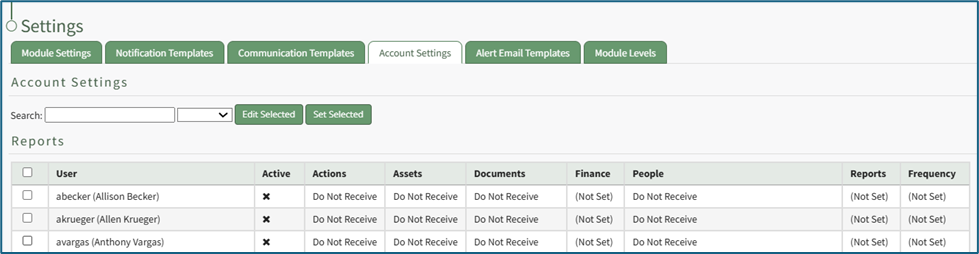
Select the existing user accounts you wish to apply the notification template to.
How To: Create New Notification Templates
Note: A default new user Notification Template already exists in the system. This template can be edited for your preferences.
How To: Edit New User Notification Templates
To edit new user notification templates, go to the Notification Templates Tab on the Settings Page of the Communications Module.
Existing templates will be shown in the Notification Template Table.
Select the edit icon in the action column of the template you wish to edit opening the Edit Notification Template Page.
A notification template is comprised of two parts: Reports and Alerts.
Indicate the desired status for email report notifications: Not Active or Active.
Alter the desired reports selected for each module or leave as “Do Not Receive”.
Email Report Frequency has three options: daily (or on specified days of the week), weekly (on the day of your choosing), or monthly (which requires the user to specify which numerical day of the month from a dropdown menu you wish to receive the report summary).
After setting template preferences for reports, scroll down to set template preferences for email alerts.
Alter email preferences as set by module through a dropdown menu with three options that designate when an email alert should be sent: “Real Time”, “Digest”, and “Do Not Receive”.
After making edits to your preferences for both Email Report and Email Alert Settings, select “Save”, returning you to the Notification Templates Tab on the Settings Page of the Communications Module.
The newly created notification template will now be shown on the Notification Template Table.
To create a new notification template, go to the Notification Templates Tab on the Settings Page of the Communications Module.
Select the “New Notification Template” button, opening the Edit Notification Template Page.
Input a name for the new Notification Template as well as a description.
A notification template is comprised of two parts: Reports and Alerts.
Indicate the desired status for email report notifications: Not Active or Active.
KAStrack generates and sends reports for the following modules: Actions, Assets, Documents, Finances, and People, and Reports.
Alter the desired reports selected for each module or leave as “Do Not Receive”.
Daily email report notifications can be sent everyday of the week, or on specific days. Select the appropriate checkboxes to indicate your preference.
Selecting a weekly email report notification requires you to indicate which day of the week you prefer the report summary email to be sent.
Selecting a monthly frequency requires the user to specify which numerical day of the month from a dropdown menu you wish to receive the report summary. The days that are not included in every month (29, 30, 31) have an asterisk next to them. If the current month does not have that particular date, the system will send the report on the final day of the month.
After setting template preferences for reports, scroll down to set template preferences for email alerts.
KAStrack sends email alerts for the following modules: Accounts, Actions, Assets, Dispatch, Documents, Finance, Forms, Meetings, and People. Each module has a dropdown menu with three options that designate when an email alert is sent: “Real Time”, “Digest”, and “Do Not Receive”.
Real Time is the default setting that sends email alerts in real time.
Digest is KAStrack’s delayed timing feature. Selecting “Digest” will summarize all alerts with this designation to be sent daily between midnight and 4 a.m. Central Time (United States). As noted in KAStrack, alert digests are not applicable to all alerts.
Whether or not an alert is digestible can be customized on the Alert Email Templates Tab of the Communications Module.
Do Not Receive designates that the user does not wish to receive email alerts about that specific module.
Communications sent from users are always sent in real time
After selecting your preferences for both Email Report and Email Alert Settings, select “Save”, returning you to the Notification Templates Tab on the Settings Page of the Communications Module.
The newly created notification template will now be shown on the Notification Template Table.

The Search textbox simplifies the search for specific users. The dropdown menu allows you to select between active / inactive users. If you wish to edit all user accounts with the same new settings, select the checkbox in the title row of the table to select all users in the table. Selecting a user in one table automatically selects them in the other.
Select the “Set Selected” button opening the Update Account Settings Modal.

The existing notification templates will show in the dropdown menu. Select the template you wish to apply to the selected user accounts.
Select “Save” for the notification template to be applied. Click “Cancel” to return to the Account Settings Tab on the Settings Page with any user accounts being impacted.
Settings Page: Alert Email Templates Tab
The Alert Email Templates Tab on the Settings Page of the Communications Module allows for the viewing of all alert templates in tabular form organized by module.

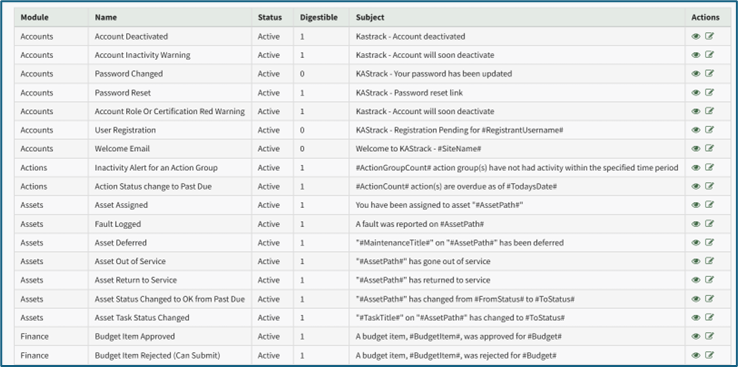
The Alert Email Templates Table shows the module name, the name of the alert, the status (Active/Inactive), if it is set to digestible (1=Yes, 0=No), and the subject of the email alert.
If an email alert is Digestible, the alert has a delayed timing feature. All digestible alerts are summarized and sent daily between midnight and 4 a.m. Central Time (United States).
There are two actions associated with the Alert Email Template Table. The eyeball icon opens the View Email config Modal. The edit icon opens the Edit Email config modal.
Mail Merge Fields Available to All Emails | |
#Username# | The username for the user receiving the email, if known |
#FirstName# | The first name for the user receiving the email, if known |
#LastName# | The first name for the user receiving the email, if known |
#FullName# | The last name for the user receiving the email, if known |
#BaseURL# | The base URL for the module |
Selecting the eyeball icon, opening the View Email config Modal, allows a user to see the email alert template including the name, a description of the alert, the subject of the email, and the body of the email (plain-text and HTML).
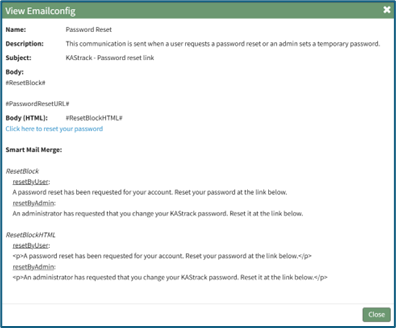
Selecting the edit icon opens the Edit Email config Modal displaying the Email Alert Template. Within this modal, the status (active/inactive), digestible status, subject, body, and smart mail merge options can all be customized for your organization’s preferences.
Settings Page: Module Levels Tab
The Module Levels Tab on the Settings Page can be accessed from the Main Menu. The system default module levels for the module are visible in the Module Levels Table. New module levels with customizable permissions can be created and managed on this tab.
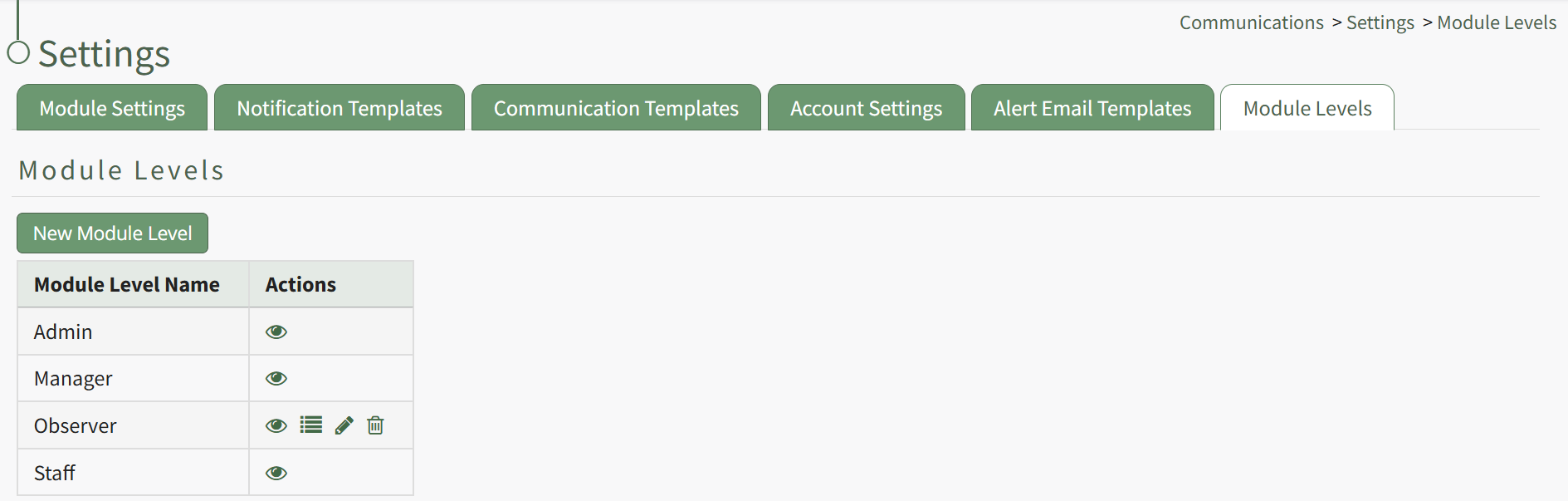
There are three system default module levels associated with the Communications Module. An explanation of the permissions associated with each default module level are shown in the Communications Module Level Permissions Table below.
System default module levels cannot be customized.
Communications Module Level Permissions Table | |
Module Level | Permissions |
Admin | send communication, advanced send comm options, edit supervised users settings, manage notification templates (new/edit/delete), edit any users settings, edit new user settings, switch on off, manage roles (view roles, add role, unassign role, role permissions, assign hidden roles, edit role, delete role, assign roles), manage email config (view, edit, delete,and revert emailconfig), setup cc email, manage communication templates (view, edit, delete communication templates) |
Manager | edit supervised users settings, view email config, send communication |
Staff | N/A |
New Module Levels can be created in order to customize module level permissions. An explanation of the icons associated with customized module levels have been provided in the table below.
Module Level Customization Icons | |
Icon | Explanation |
| The eyeball icon allows you to view users assigned to the module level as well as the permissions assigned to them. |
| The bulleted list icon allows you to assign permissions to customized module levels. |
| The pencil icon opens the Edit Module Level Modal. |
| The trashcan icon opens the Delete Module Level Confirmation Modal. |


How To: Create a New Module Level (Communications Module)
To create a new module level, go to the Module Levels Tab on the Settings Page of the Communications Module.
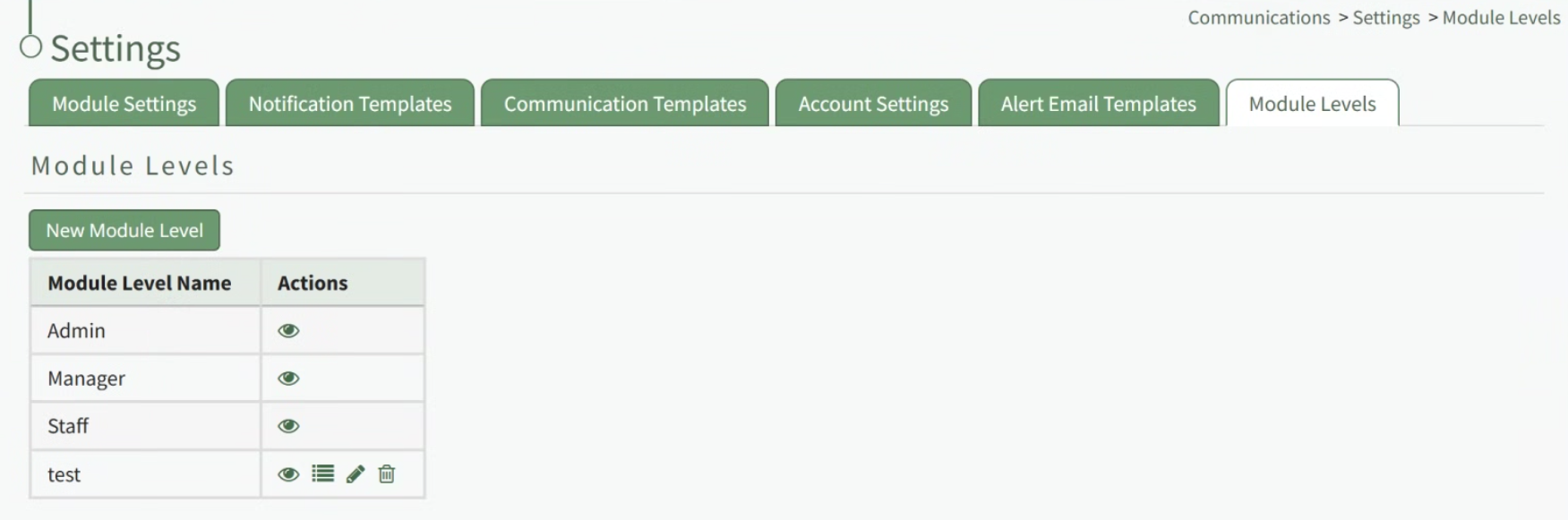
Select the “New Module Level” button opening the New Module Level Modal.
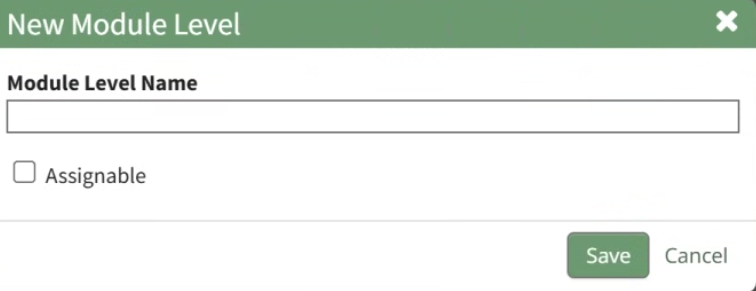
Input the new Module Level Name.
Select the “Assignable” checkbox, so that the module level can be assigned to users.
Click “Cancel” to return to the Module Levels Tab on the Communications Page without creating a new module level. Select “Save” and the new module level will show on the Module Level Table.
Users can select which permissions are allowed for a customized module level. Select the Permissions icon (the bullet point list to the right of the eye) to assign the permissions the new Module Level would have within the Communications Module.

Select “Save” and the permissions are now assigned to the Module Level.
Access levels for all modules can be managed in the Site Settings Module on the Access Levels Tab.
A complete list of all permissions associated with the Communications Module have been provided below.

Communications: Supplemental Resources
Communications Email Alert Summary
Users can enable and set their own notifications preferences for system emails on the Notifications Tab of the My Accounts Page in the Accounts Module.
How To: Edit Email Report / Alert Settings for Existing Users
To edit email report / alert settings for existing accounts, go to the Account Settings Tab on the Settings Page of the Communications Module.
Select the users whose email report/ alerts notification settings you wish to edit.
The Search textbox simplifies the search for specific users. The dropdown menu allows you to select between users’ current statuses for Reports/Alerts receipt. If you wish to edit all user accounts with the same new settings, select the checkbox in the title row of the table to select all users in the table. Selecting a user in one table automatically selects them in the other.
Select the “Edit Selected” button, opening the Update Account Settings Modal.
Make the desired changes for both email reports/alerts that you would like to apply to the pre-selected users.
Select “Save” for the notification preferences to be altered. Click “Cancel” to return to the Account Settings Tab on the Settings Page with any user accounts being impacted.
| |
Email Alert | Digestible |
Custom Communication | Sent in Real Time Only |
Administrators can update the system default settings (including whether they are sent in real-time or digestible) for alert emails on the Settings Page of the Communications Module.
WIKI LINK EMAIL SETTINGS > MODULE SETTINGS TAB > COMMUNICATIONS MODULE
Complete List of Communications Module How Tos
How To: Apply a Notification Template to Existing Accounts
To apply notification templates to existing accounts, go to the Account Settings Tab on the Settings Page of the Communications Module.
Select the existing user accounts you wish to apply the notification template to.
How To: Create New Notification Templates
Note: A default new user Notification Template already exists in the system. This template can be edited for your preferences.
How To: Edit New User Notification Templates
{{@111}}
To create a new notification template, go to the Notification Templates Tab on the Settings Page of the Communications Module.
Select the “New Notification Template” button, opening the Edit Notification Template Page.
Input a name for the new Notification Template as well as a description.
A notification template is comprised of two parts: Reports and Alerts.
Indicate the desired status for email report notifications: Not Active or Active.
KAStrack generates and sends reports for the following modules: Actions, Assets, Documents, Finances, and People, and Reports.
Alter the desired reports selected for each module or leave as “Do Not Receive”.
Daily email report notifications can be sent everyday of the week, or on specific days. Select the appropriate checkboxes to indicate your preference.
Selecting a weekly email report notification requires you to indicate which day of the week you prefer the report summary email to be sent.
Selecting a monthly frequency requires the user to specify which numerical day of the month from a dropdown menu you wish to receive the report summary. The days that are not included in every month (29, 30, 31) have an asterisk next to them. If the current month does not have that particular date, the system will send the report on the final day of the month.
After setting template preferences for reports, scroll down to set template preferences for email alerts.
KAStrack sends email alerts for the following modules: Accounts, Actions, Assets, Dispatch, Documents, Finance, Forms, Meetings, and People. Each module has a dropdown menu with three options that designate when an email alert is sent: “Real Time”, “Digest”, and “Do Not Receive”.
Real Time is the default setting that sends email alerts in real time.
Digest is KAStrack’s delayed timing feature. Selecting “Digest” will summarize all alerts with this designation to be sent daily between midnight and 4 a.m. Central Time (United States). As noted in KAStrack, alert digests are not applicable to all alerts.
Whether or not an alert is digestible can be customized on the Alert Email Templates Tab of the Communications Module.
Do Not Receive designates that the user does not wish to receive email alerts about that specific module.
Communications sent from users are always sent in real time
After selecting your preferences for both Email Report and Email Alert Settings, select “Save”, returning you to the Notification Templates Tab on the Settings Page of the Communications Module.
The newly created notification template will now be shown on the Notification Template Table.
The Search textbox simplifies the search for specific users. The dropdown menu allows you to select between active / inactive users. If you wish to edit all user accounts with the same new settings, select the checkbox in the title row of the table to select all users in the table. Selecting a user in one table automatically selects them in the other.
Select the “Set Selected” button opening the Update Account Settings Modal.
The existing notification templates will show in the dropdown menu. Select the template you wish to apply to the selected user accounts.
Select “Save” for the notification template to be applied. Click “Cancel” to return to the Account Settings Tab on the Settings Page with any user accounts being impacted.
How To: Attach a Documents Module File To an Email
To attach a documents module file to a system message, open the Send Communications Page in the Communications Module from the Main Menu.
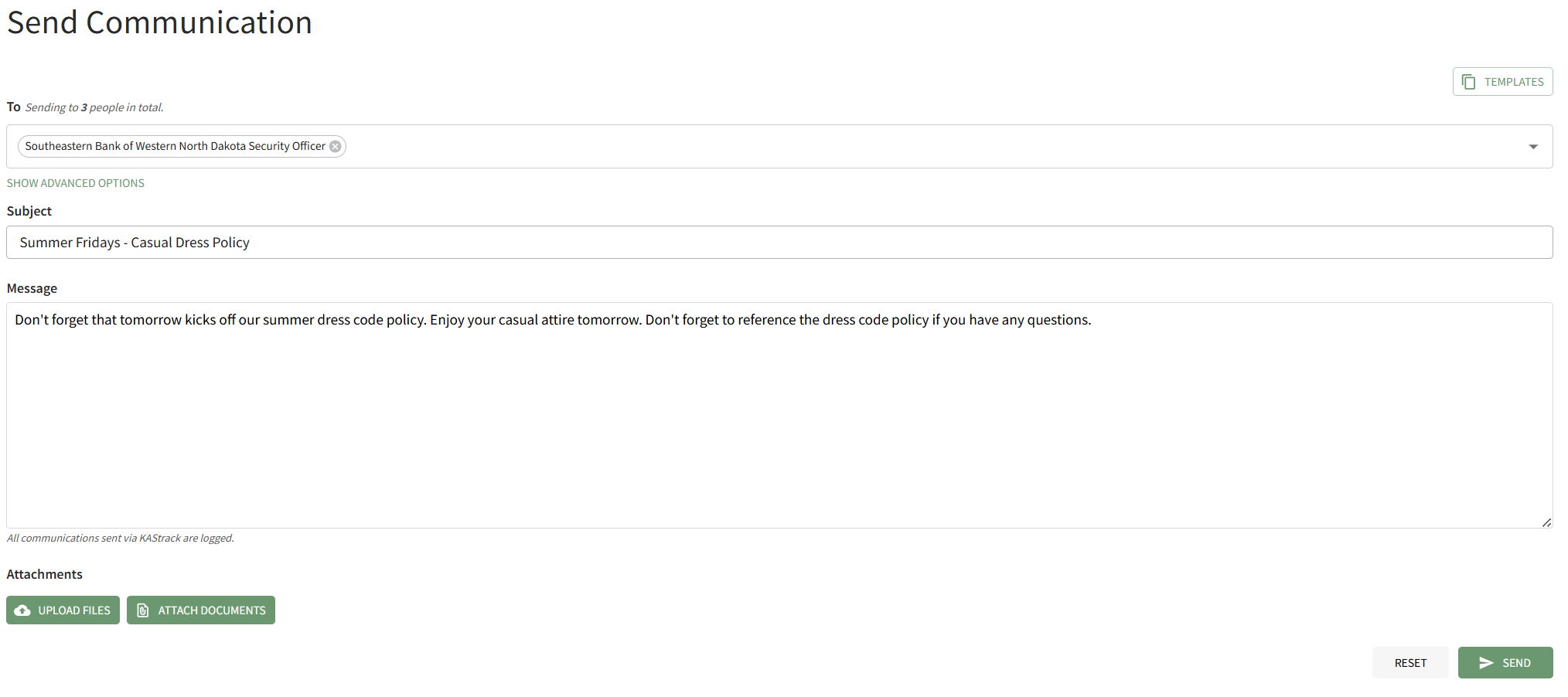
Click the "Attach Documents" button on the bottom left-hand side of the page opening the Attach Documents Modal.
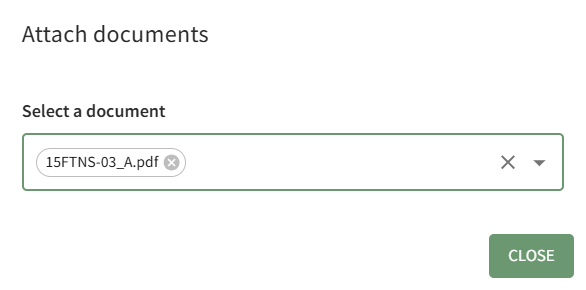
Choose the file you wish to attach to the system message from the dropdown menu. It will automatically attach it to the bottom of the Send Communication page. Click the"Close" button on the modal to return to the Send Communications Page.
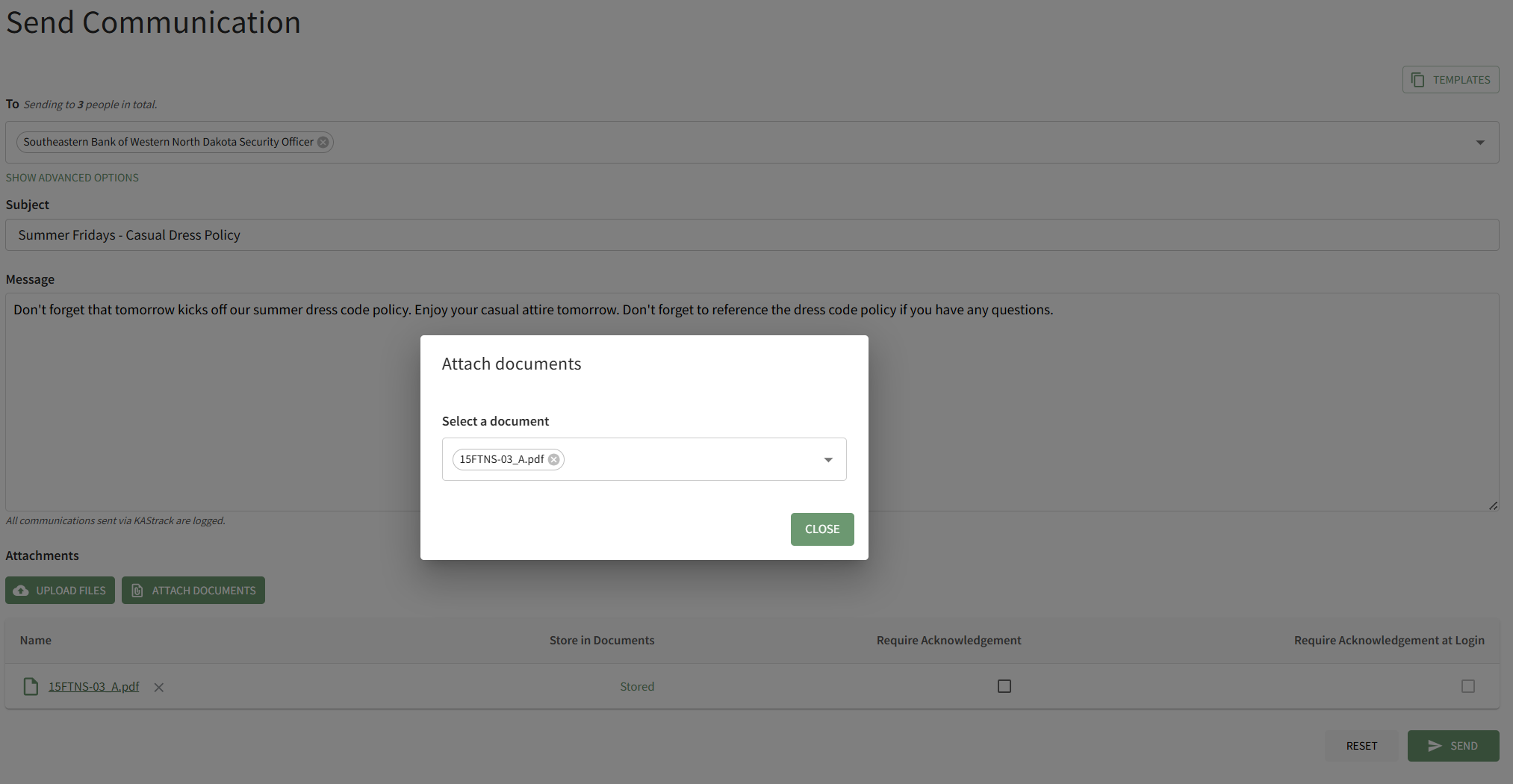
Checkboxes to the right of the attachment allow you to require acknowledgement of the attached file from the Documents Module, or to require acknowledgement of the attached file immediately when the message recipients login to the system next.

After make the appropriate selections, click "Send" on the bottom right-hand side of the page to send the system message.
How To: Attach a File to an Email
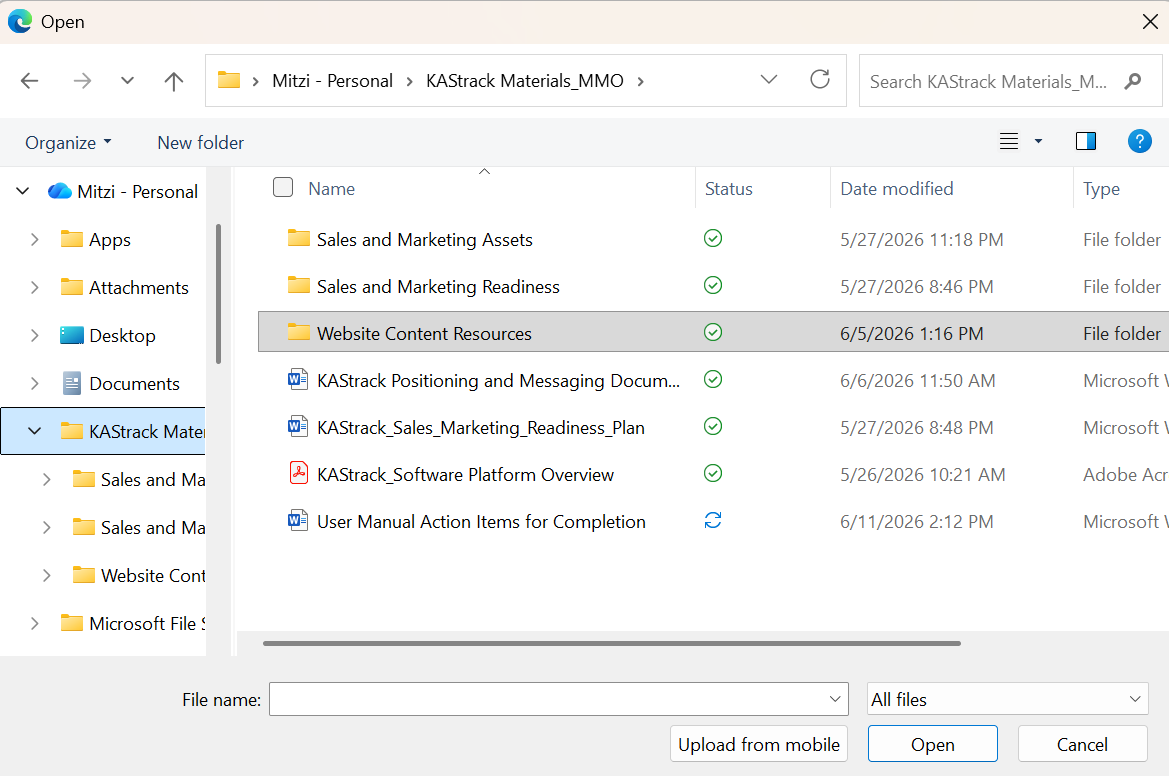
To attach a file to a system message in KAStrack, open the Send Communications Page in the Communications Module on the Main Menu. After inputting all information, click the "Upload Files" button on the bottom left-hand side of the page.
This will open your personal device so that you can access the file you wish to attach to the system message.
After selecting the appropriate file, it will be visible at the bottom of the Send Communications Page.
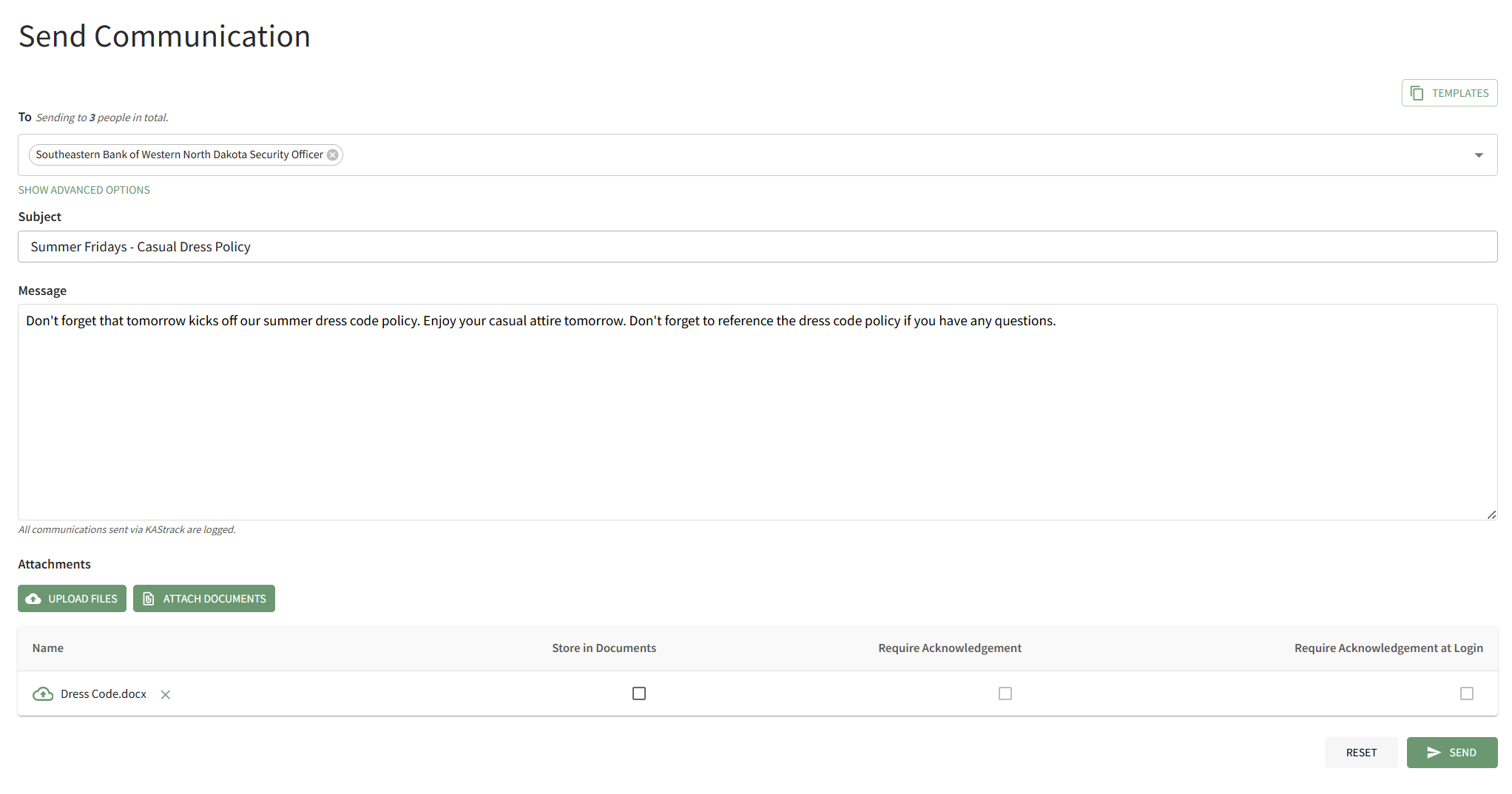
Checkboxes allow you to upload the file from your personal device to the Documents Module, to requirement acknowledgement of the document from the users who receive it, or to require acknowledgment of the document immediately when the user logs in to the system. After making the appropriate selections, press "Send" on the bottom right-hand corner of the page.
How To: Copy a QR Code
To copy an individual QR Code, open the QR Code Page of the Communications Module from the Main Menu.
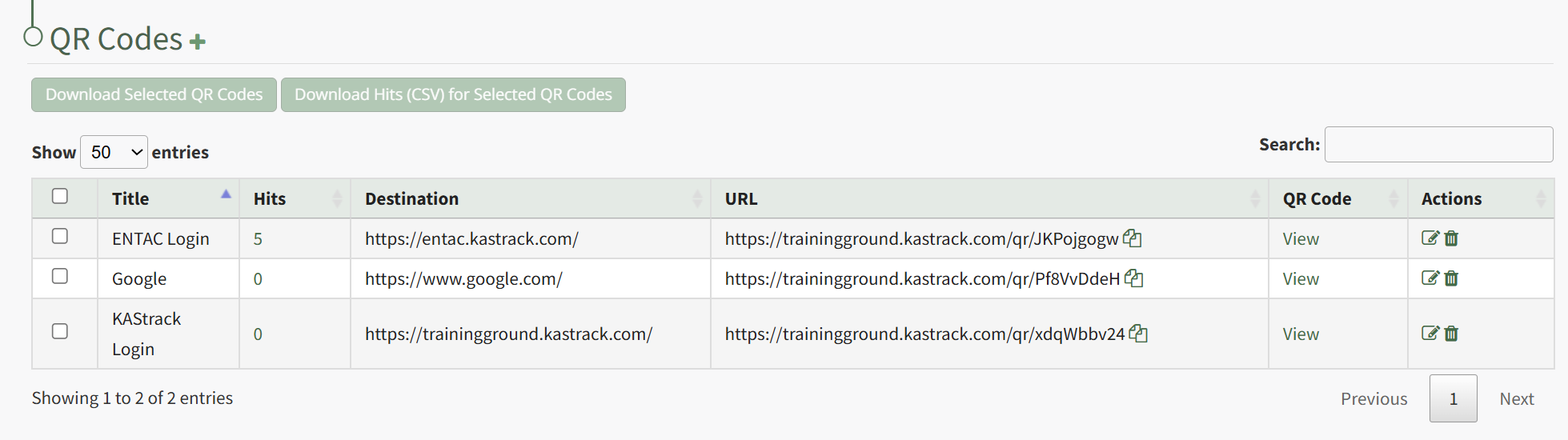
Click "View" in the QR Code Column to the right of the specific QR Code you wish to view. This opens the QR Code Modal and displays the specified QR Code.
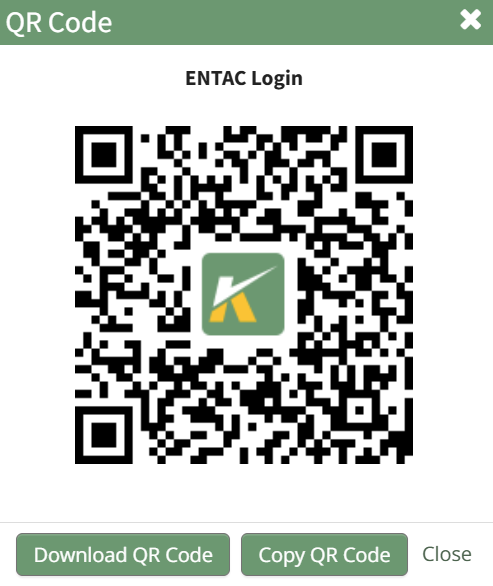
Click the "Copy QR Code" button, and you can now paste the specified QR Code as needed.
How To: Copy a QR Code's Destination URL Link
To copy the Destination URL Link associated with a specific QR Code, open the QR Code Page in the Communications Module from the Main Menu.
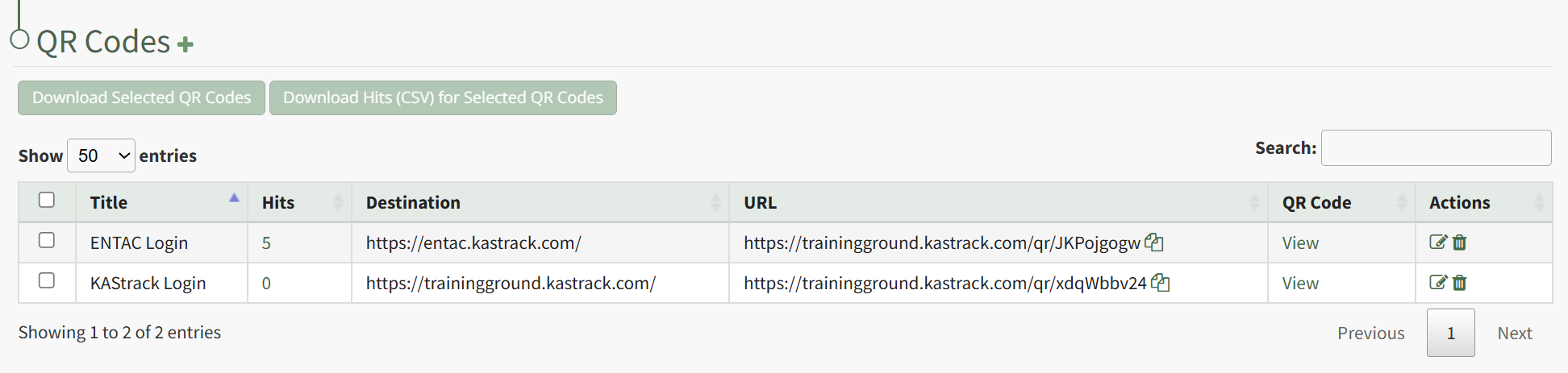
Click the double page icon to the right of the URL Link in the URL Column.
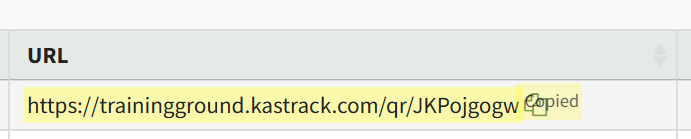
The URL Link is briefly highlighted, confirming that the link has been copied and is ready to be pasted as needed.
How To: Create a Custom QR Code
To create a custom QR Code, open the QR Code Page in the Communications Module from the Main Menu.

Click the plus sign icon immediately to the right of the page header. This opens the New QR Code Modal.
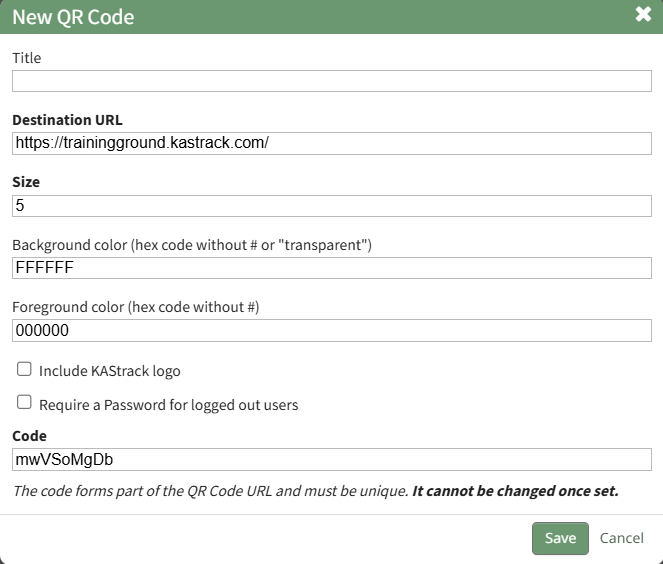
Input the Title for the new QR code.
The system will automatically input the login page for your KAStrack domain. Input your desired destination URL.
The system automatically inputs 5 as the size. A larger integer will increase the size. A smaller integer will decrease the size.
Both the background and foreground color of the QR Code can be customized. Input the desired hex code for each without the #.
Select the "Include a KAStrack logo" checkbox if you would like the KAStrack logo to be inserted into the middle of the QR code.
Select the "Require a password for logged out users" checkbox if you would like to require a password to access the destination URL.
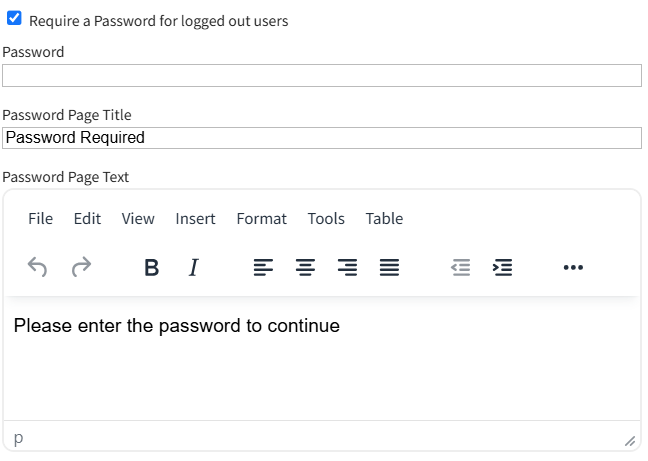
This expands the Modal so that you can input a password and design the Password Page.
If the Destination URL is a KAStrack page, only individuals with permission to access the page in the system will be able to access it through the QR code.
The System generates a default code for every new QR Code. It must be unique. You can edit this code if desired, but once the code is set it cannot be altered.
After making the desired customizations for your QR Code, click the "Save" button at the bottom of the modal.

The new QR Code is now visible in the QR Code Table.
How To: Create a New Module Level (Communications Module)
To create a new module level, go to the Module Levels Tab on the Settings Page of the Communications Module.
Select the “New Module Level” button opening the New Module Level Modal.
Input the new Module Level Name.
Select the “Assignable” checkbox, so that the module level can be assigned to users.
Click “Cancel” to return to the Module Levels Tab on the Communications Page without creating a new module level. Select “Save” and the new module level will show on the Module Level Table.
Users can select which permissions are allowed for a customized module level. Select the Permissions icon (the bullet point list to the right of the eye) to assign the permissions the new Module Level would have within the Communications Module.
Select “Save” and the permissions are now assigned to the Module Level.
Access levels for all modules can be managed in the Site Settings Module on the Access Levels Tab.
How To: Create New Communication Templates
To create a new communication template, go to the Communication Templates Tab on the Settings Page of the Communications Module.
Select the “New Communication Template” button opening the New Template Modal.
Input the Title for the Template.
Select Active / Inactive from the dropdown menu to indicate if the template is available for use.
Both individual people and certification roles can be selected as desired recipients via dropdown menu in the “Send To” line.
Include the subject line for communications, as well as a message.
An attachment can be uploaded from your personal device to be included in the template, or you have the option to select one or more files from KAStrack’s Document Module.
KAStrack documents that are tagged may limit visibility of this template. Specifically, if a template contains a tagged document you cannot see, you will be unable to see the template when sending a communication. Individuals with access to a Document that has visibility restrictions for others via Tags cannot use Send Communication to send that tagged Document to users that lack the authorization to see it.
Select “Save” and the New Communications Template will show in the Communications Template Table on the Settings Page.
The template can now be applied as desired when sending communications in the system on the Send Communications Page. You can also click the closed envelope symbol in the Communication Templates table to go to the Send Communications page and pre-fill the chosen template.
How To: Create New Notification Templates
Note: A default new user Notification Template already exists in the system. This template can be edited for your preferences.
How To: Edit New User Notification Templates
To edit new user notification templates, go to the Notification Templates Tab on the Settings Page of the Communications Module.
Existing templates will be shown in the Notification Template Table.
Select the edit icon in the action column of the template you wish to edit opening the Edit Notification Template Page.
A notification template is comprised of two parts: Reports and Alerts.
Indicate the desired status for email report notifications: Not Active or Active.
Alter the desired reports selected for each module or leave as “Do Not Receive”.
Email Report Frequency has three options: daily (or on specified days of the week), weekly (on the day of your choosing), or monthly (which requires the user to specify which numerical day of the month from a dropdown menu you wish to receive the report summary).
After setting template preferences for reports, scroll down to set template preferences for email alerts.
Alter email preferences as set by module through a dropdown menu with three options that designate when an email alert should be sent: “Real Time”, “Digest”, and “Do Not Receive”.
After making edits to your preferences for both Email Report and Email Alert Settings, select “Save”, returning you to the Notification Templates Tab on the Settings Page of the Communications Module.
The newly created notification template will now be shown on the Notification Template Table.
To create a new notification template, go to the Notification Templates Tab on the Settings Page of the Communications Module.
Select the “New Notification Template” button, opening the Edit Notification Template Page.
Input a name for the new Notification Template as well as a description.
A notification template is comprised of two parts: Reports and Alerts.
Indicate the desired status for email report notifications: Not Active or Active.
KAStrack generates and sends reports for the following modules: Actions, Assets, Documents, Finances, and People, and Reports.
Alter the desired reports selected for each module or leave as “Do Not Receive”.
Daily email report notifications can be sent everyday of the week, or on specific days. Select the appropriate checkboxes to indicate your preference.
Selecting a weekly email report notification requires you to indicate which day of the week you prefer the report summary email to be sent.
Selecting a monthly frequency requires the user to specify which numerical day of the month from a dropdown menu you wish to receive the report summary. The days that are not included in every month (29, 30, 31) have an asterisk next to them. If the current month does not have that particular date, the system will send the report on the final day of the month.
After setting template preferences for reports, scroll down to set template preferences for email alerts.
KAStrack sends email alerts for the following modules: Accounts, Actions, Assets, Dispatch, Documents, Finance, Forms, Meetings, and People. Each module has a dropdown menu with three options that designate when an email alert is sent: “Real Time”, “Digest”, and “Do Not Receive”.
Real Time is the default setting that sends email alerts in real time.
Digest is KAStrack’s delayed timing feature. Selecting “Digest” will summarize all alerts with this designation to be sent daily between midnight and 4 a.m. Central Time (United States). As noted in KAStrack, alert digests are not applicable to all alerts.
Whether or not an alert is digestible can be customized on the Alert Email Templates Tab of the Communications Module.
Do Not Receive designates that the user does not wish to receive email alerts about that specific module.
Communications sent from users are always sent in real time
After selecting your preferences for both Email Report and Email Alert Settings, select “Save”, returning you to the Notification Templates Tab on the Settings Page of the Communications Module.
The newly created notification template will now be shown on the Notification Template Table.
How To: Delete a QR Code
To delete a QR Code, open the QR Page in the Communications Module from the Main Menu.
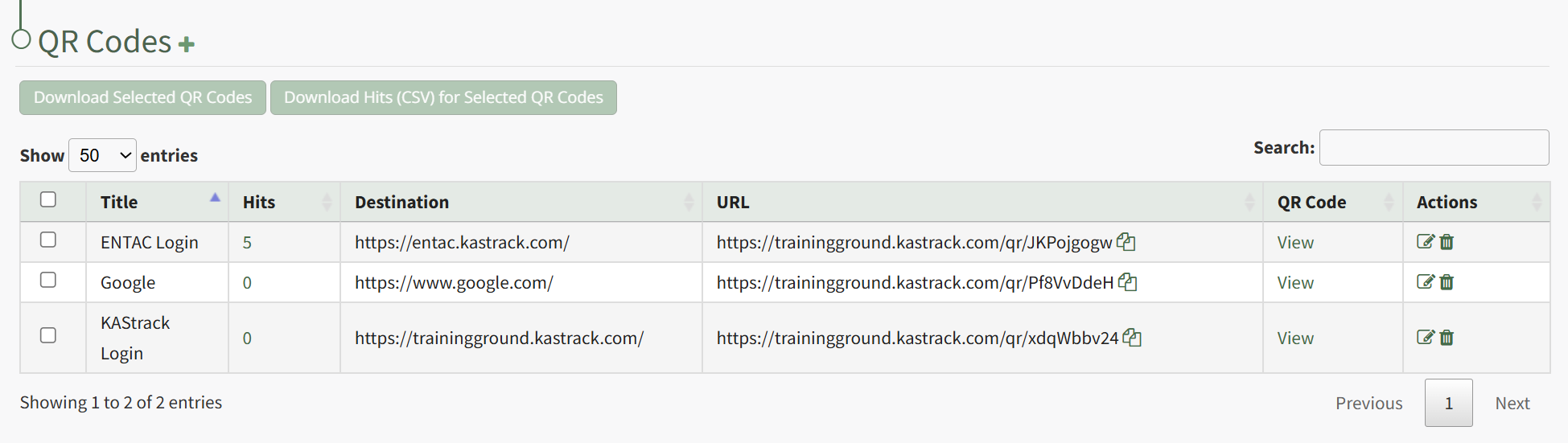
Click the trashcan icon in the Actions Column to the right of the QR Code you wish to delete.
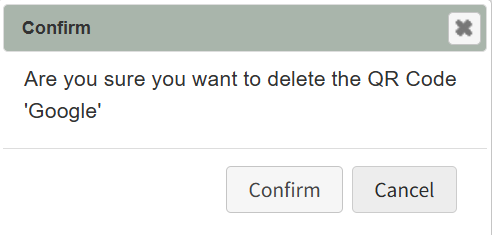
This opens the QR Code Deletion Confirmation Modal, which states "Are you sure you want to delete the QR Code?" Click Confirm.
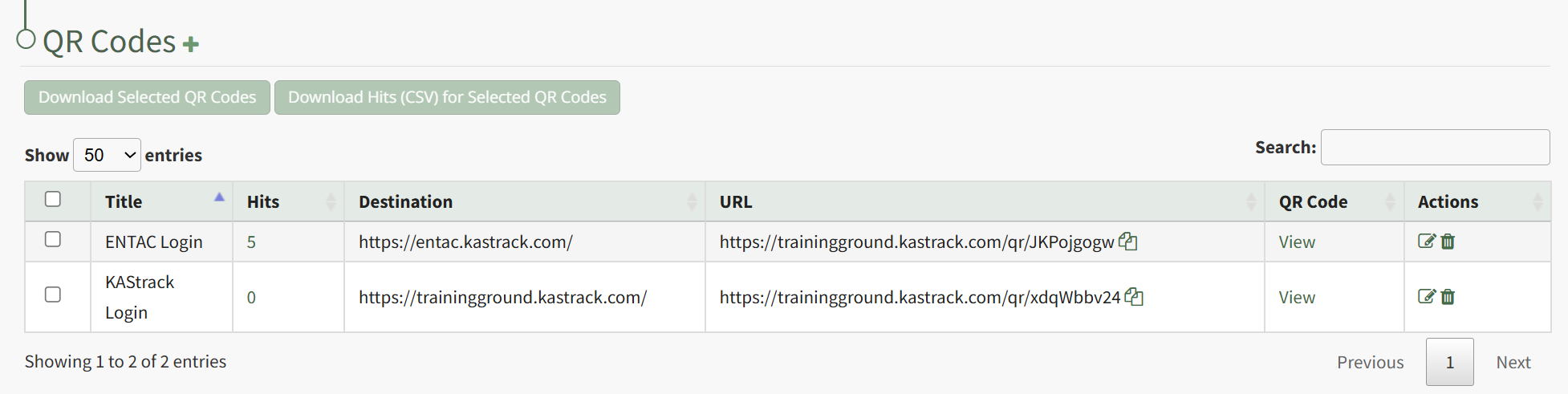
The QR Code is permanently deleted from the QR Code Table.
How To: Download an Individual QR Code
To download an individual QR Code, open the QR Code Page of the Communications Module from the Main Menu.
Click "View" in the QR Code Column to the right of the specific QR Code you wish to view. This opens the QR Code Modal and displays the specified QR Code.
Click the "Download QR Code" button,
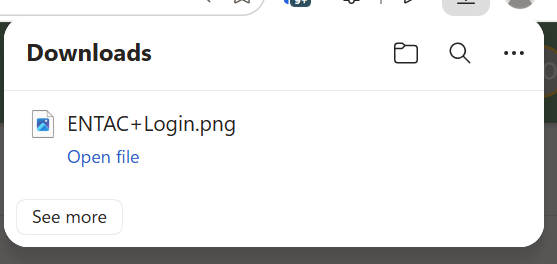
This automatically downloads the specified QR Code to your personal device.
How To: Download Multiple QR Codes at Once
To download multiple QR Codes at once, open the QR Page in the Communications Module from the Main Menu.
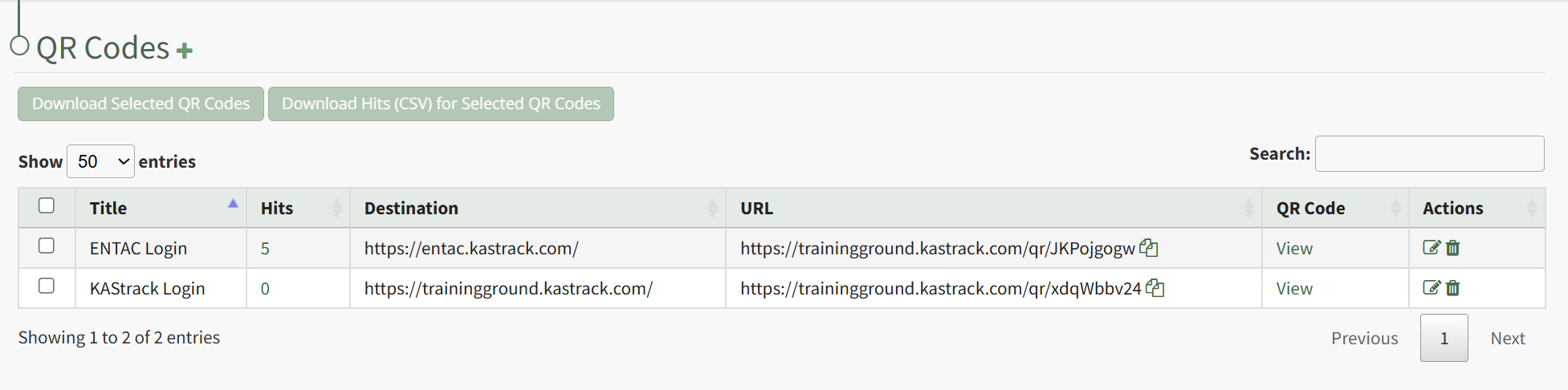
Click the checkboxes to the right of the QR Codes you wish to download, or click the checkbox in the top header row to select all QR Codes.
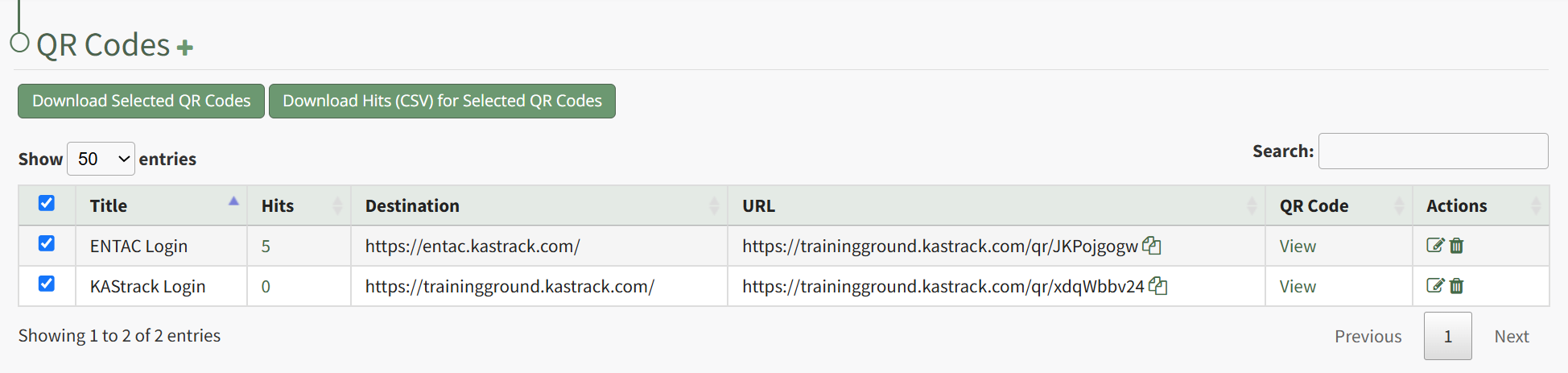
After selecting a checkbox, the buttons beneath the header can now be used. Click the "Download Selected QR Codes" button.
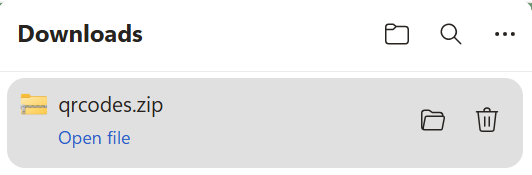
The selected QR Codes will automatically download as a .zip file to your personal device.
How To: Download QR Code Hits Data in a CSV File
To download the number of hits associated with a QR Code in a CSV file, open the QR Page in the Communications Module from the Main Menu.
Click the checkboxes to the right of the QR Codes you wish to download hit data for or click the checkbox in the top header row to download data for all QR Codes.
After selecting the desired checkboxes, click the "Download Hits (CSV) for Selected QR Codes" button.
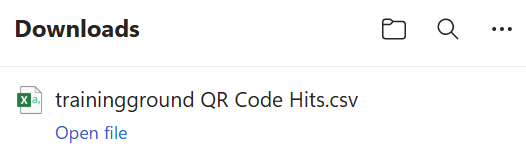
The .csv file will automatically download to your personal device.
How To: Edit a QR Code
To edit a custom QR Code, open the QR Code Page in the Communications Module from the Main Menu.
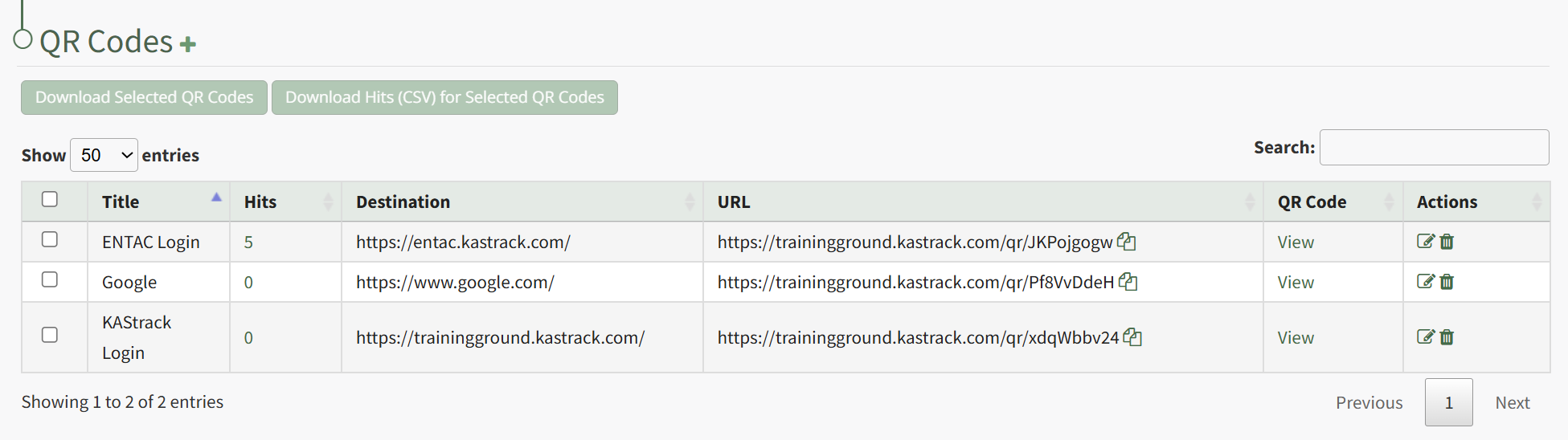
Click the page and pencil icon in the Actions Column to the right of the QR Code you want to edit, opening the Edit QR Code Modal.
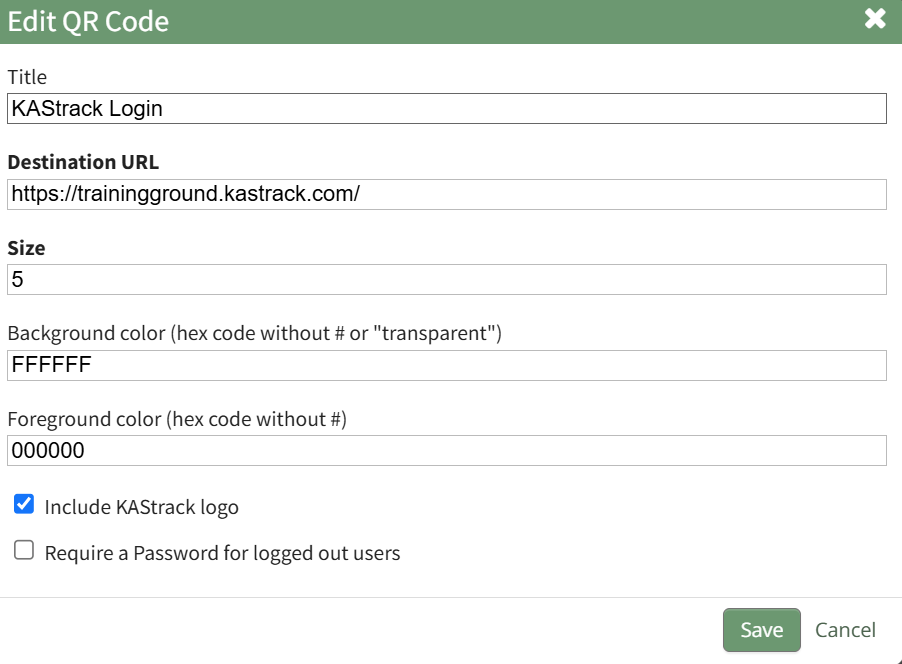
Make the desired changes to the QR Code and click the Save button. The system returns you to the QR Codes Page.
How To: Edit Email Report/Alert Notification Settings for Existing Accounts
To edit email report / alert settings for existing accounts, go to the Account Settings Tab on the Settings Page of the Communications Module.
Select the users whose email report/ alerts notification settings you wish to edit.
The Search textbox simplifies the search for specific users. The dropdown menu allows you to select between users’ current statuses for Reports/Alerts receipt. If you wish to edit all user accounts with the same new settings, select the checkbox in the title row of the table to select all users in the table. Selecting a user in one table automatically selects them in the other.
Select the “Edit Selected” button, opening the Update Account Settings Modal.
Make the desired changes for both email reports/alerts that you would like to apply to the pre-selected users.
Select “Save” for the notification preferences to be altered. Click “Cancel” to return to the Account Settings Tab on the Settings Page with any user accounts being impacted.
How To: Edit New User Notification Templates
To edit new user notification templates, go to the Notification Templates Tab on the Settings Page of the Communications Module.
Existing templates will be shown in the Notification Template Table.
Select the edit icon in the action column of the template you wish to edit opening the Edit Notification Template Page.
A notification template is comprised of two parts: Reports and Alerts.
Indicate the desired status for email report notifications: Not Active or Active.
Alter the desired reports selected for each module or leave as “Do Not Receive”.
Email Report Frequency has three options: daily (or on specified days of the week), weekly (on the day of your choosing), or monthly (which requires the user to specify which numerical day of the month from a dropdown menu you wish to receive the report summary).
After setting template preferences for reports, scroll down to set template preferences for email alerts.
Alter email preferences as set by module through a dropdown menu with three options that designate when an email alert should be sent: “Real Time”, “Digest”, and “Do Not Receive”.
After making edits to your preferences for both Email Report and Email Alert Settings, select “Save”, returning you to the Notification Templates Tab on the Settings Page of the Communications Module.
The newly created notification template will now be shown on the Notification Template Table.
How To: Reset the Hit Count on a QR Code
To reset the hit count for a specific QR Code, open the QR Code page of the Communications Module from the Main Menu.
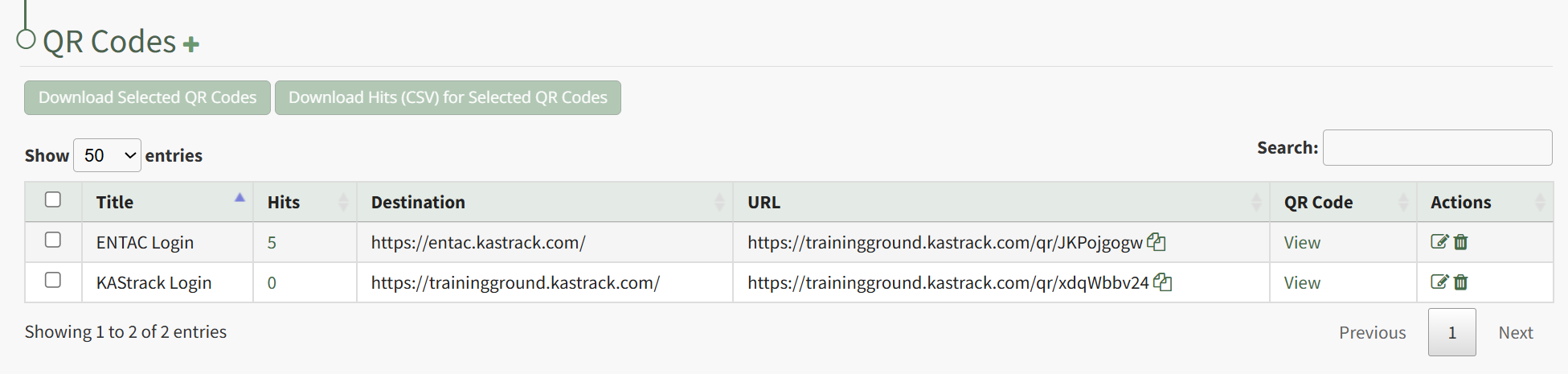
Click on the integer in the Hits Column of the QR Code whose count you wish to reset.
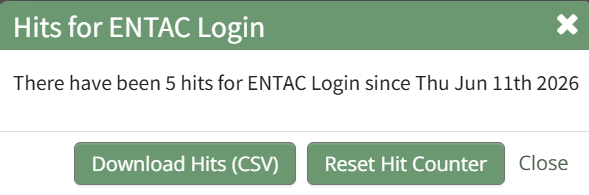
This opens the HIts For QR Code Modal, which states the number of hits and the data that the QR Code was last used. Click the "Reset Hit Counter" button on the modal, opening a Reset Confirmation Modal.
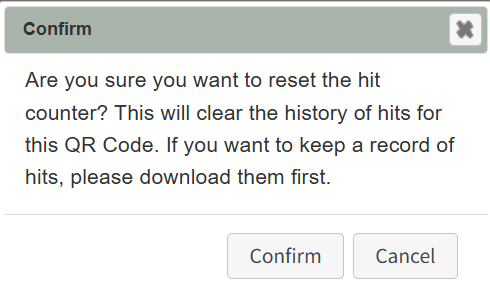
The modal states, "Are you sure you want to reset the hit counter? This will clear the history of hits for this QR Code. If you want to keep a record of hits, please download them first." Click the "Confirm" button.
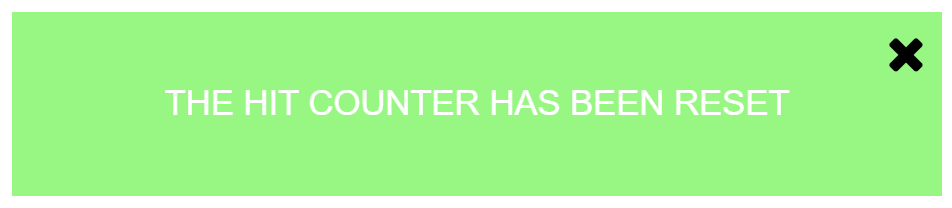
A pop-up modal confirms that the counter has been reset.
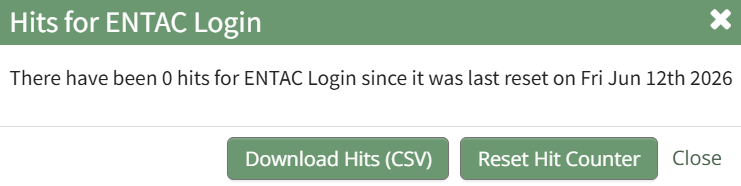
The Hits for QR Code Modal shows that the count is 0 and states the reset date.
How To: Send an Email in KAStrack
To send a system email in KAStrack, open the Send Communications Page in the Communications Module from the Main Menu.
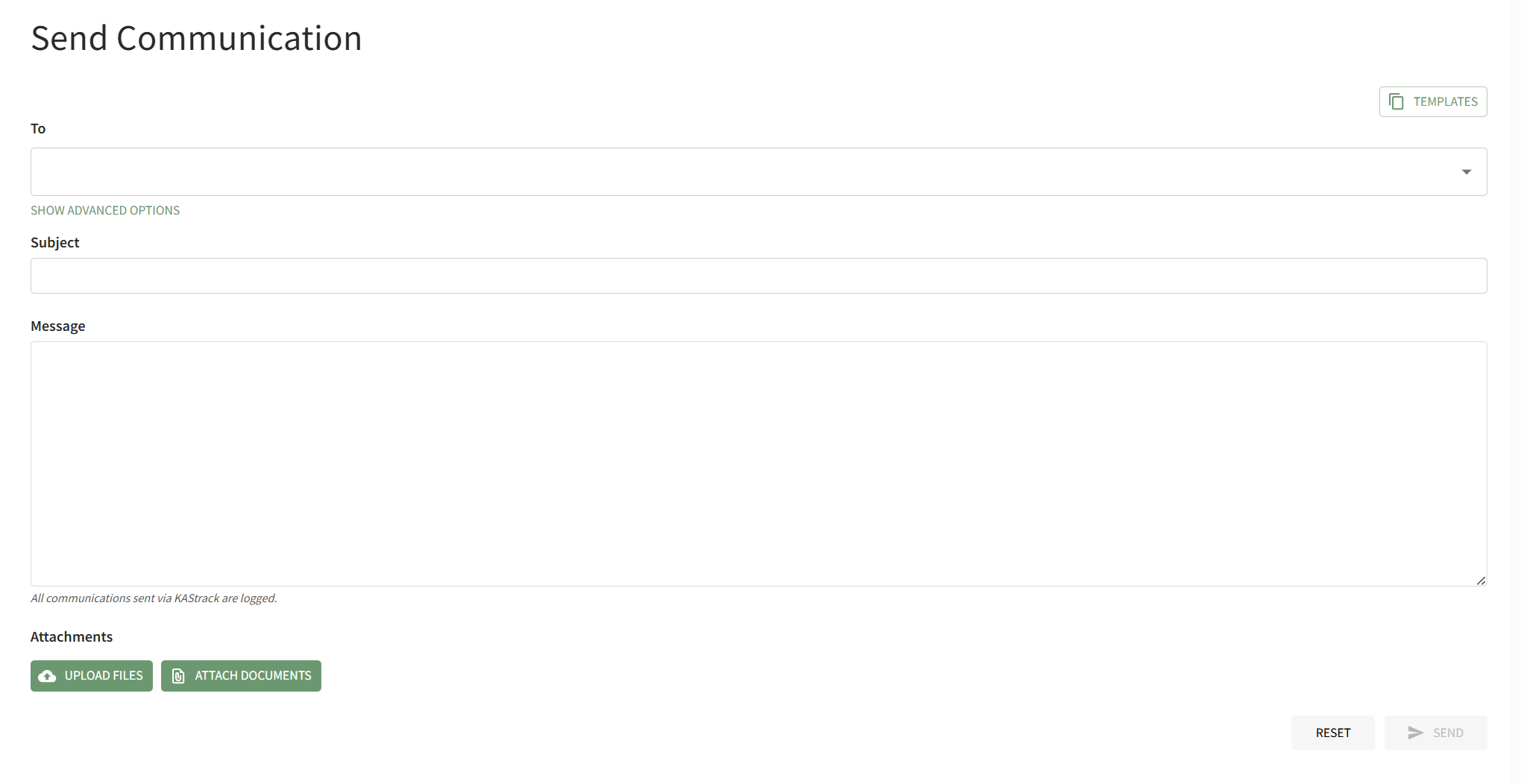
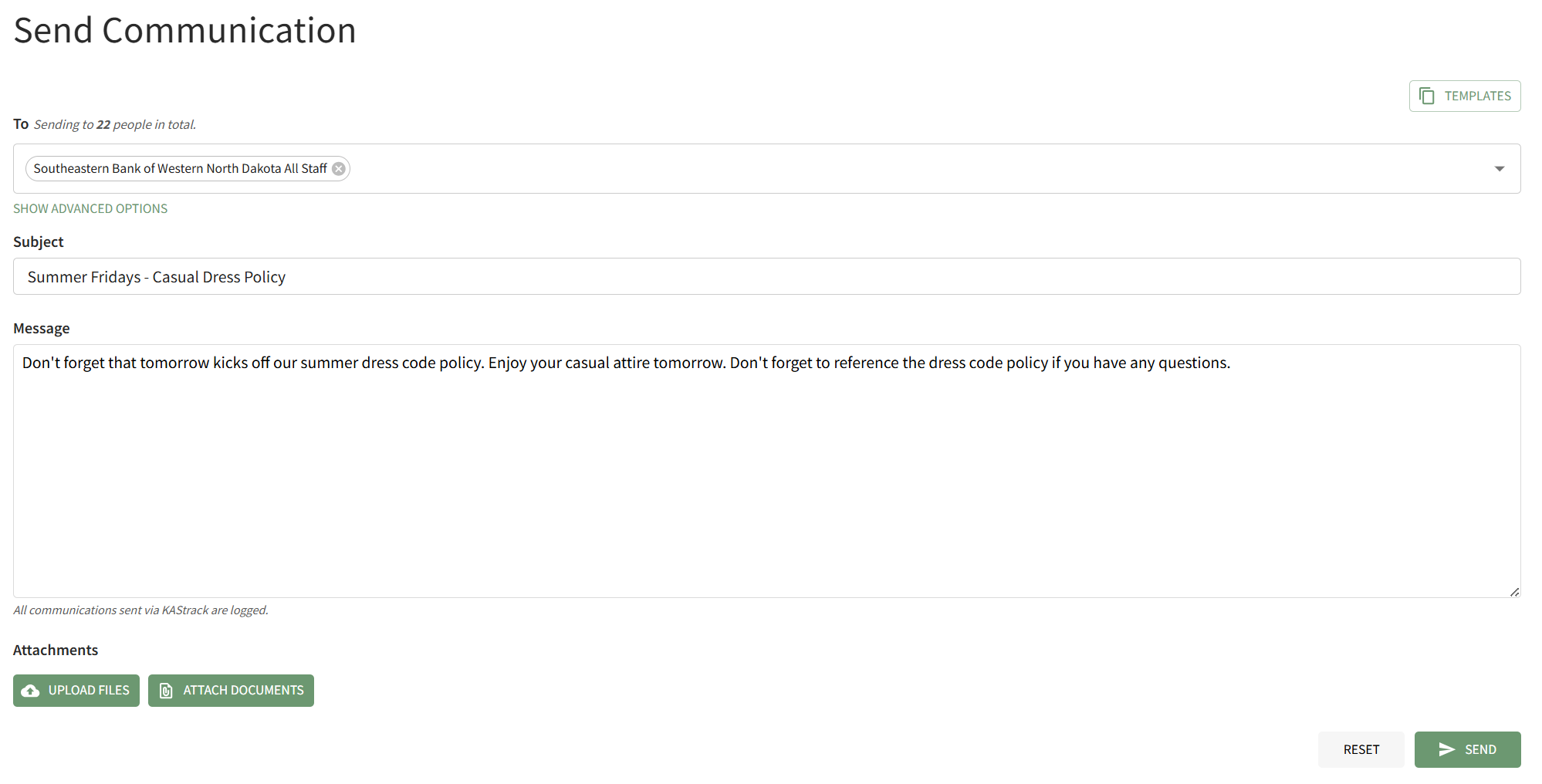
Select the individual users, certification roles or access levels you wish to send the message to from the dropdown menu in the "To" field. Input the Subject and Message.
Individuals with an Admin Access Level have access to advanced options.
How To: Attach a File to an Email
To attach a file to a system message in KAStrack, open the Send Communications Page in the Communications Module on the Main Menu. After inputting all information, click the "Upload Files" button on the bottom left-hand side of the page.
This will open your personal device so that you can access the file you wish to attach to the system message.
After selecting the appropriate file, it will be visible at the bottom of the Send Communications Page.
Checkboxes allow you to upload the file from your personal device to the Documents Module, to requirement acknowledgement of the document from the users who receive it, or to require acknowledgment of the document immediately when the user logs in to the system. After making the appropriate selections, press "Send" on the bottom right-hand corner of the page.
How To: Attach A Documents Module File to an Email
To attach a documents module file to a system message, open the Send Communications Page in the Communications Module from the Main Menu.
Click the "Attach Documents" button on the bottom left-hand side of the page opening the Attach Documents Modal.
Choose the file you wish to attach to the system message from the dropdown menu. It will automatically attach it to the bottom of the Send Communication page. Click the"Close" button on the modal to return to the Send Communications Page.
Checkboxes to the right of the attachment allow you to require acknowledgement of the attached file from the Documents Module, or to require acknowledgement of the attached file immediately when the message recipients login to the system next.
After make the appropriate selections, click "Send" on the bottom right-hand side of the page to send the system message.
When you are ready to send the system message, click the "Send" button in the bottom right-hand corner of the page.
If there is an error sending the message, the system will communicate that through a modal at the bottom of the page.

You will automatically return to the Send Communications Page so that the issue can be addressed.
How To: Set Up Additional Account Fields for Email Settings
To utilize the CC and BCC Email Settings on the Module Settings Tab of the Settings Page in the Communications Module, you must first set up additional user account information fields.
To set up additional user account information fields with email settings, go to the Account Fields Tab of the Site Settings Module.
Select “Add a Field” beneath the Custom / Additional User Account Information Fields opening the Add Field Modal.
Enter a Label for the new field, and select “email” as the type of field.
The checkboxes below allow for customization. Select “Allow multiple values” if there could be multiple emails associated with this field for an account. Select “Required” if you would like to require that this field be filled out for each account. Selecting the “Sensitive field” checkbox will tell KAStrack not to show this information when the field is being included in a report or form entry.
Select the permissions to be granted for each Accounts Module Level for this field, communicating if each Module Level can view their own/others and edit their own/others.
Under Accounts Module Level in the permissions grid, “Logged out user” refers to how fields will be displayed to users creating their account via a Registration Profile Link. To allow users to fill in information for the chosen field, ensure that the Edit Own permission is enabled for that field for “Logged out user”.
Select “Save” to create the new account information field.
The newly created email account fields will now show on the Account Info: (UserName) Page.
How To: Use a Communications Template when Sending An Email
To use a communications template, the template must first be created.
How To: Create New Communication Templates
To create a new communication template, go to the Communication Templates Tab on the Settings Page of the Communications Module.
Select the “New Communication Template” button opening the New Template Modal.
Input the Title for the Template.
Select Active / Inactive from the dropdown menu to indicate if the template is available for use.
Both individual people and certification roles can be selected as desired recipients via dropdown menu in the “Send To” line.
Include the subject line for communications, as well as a message.
An attachment can be uploaded from your personal device to be included in the template, or you have the option to select one or more files from KAStrack’s Document Module.
KAStrack documents that are tagged may limit visibility of this template. Specifically, if a template contains a tagged document you cannot see, you will be unable to see the template when sending a communication. Individuals with access to a Document that has visibility restrictions for others via Tags cannot use Send Communication to send that tagged Document to users that lack the authorization to see it.
Select “Save” and the New Communications Template will show in the Communications Template Table on the Settings Page.
The template can now be applied as desired when sending communications in the system on the Send Communications Page. You can also click the closed envelope symbol in the Communication Templates table to go to the Send Communications page and pre-fill the chosen template.
To use a pre-existing communications template, go to the Send Communications Page in the Communications Module from the Main Menu.
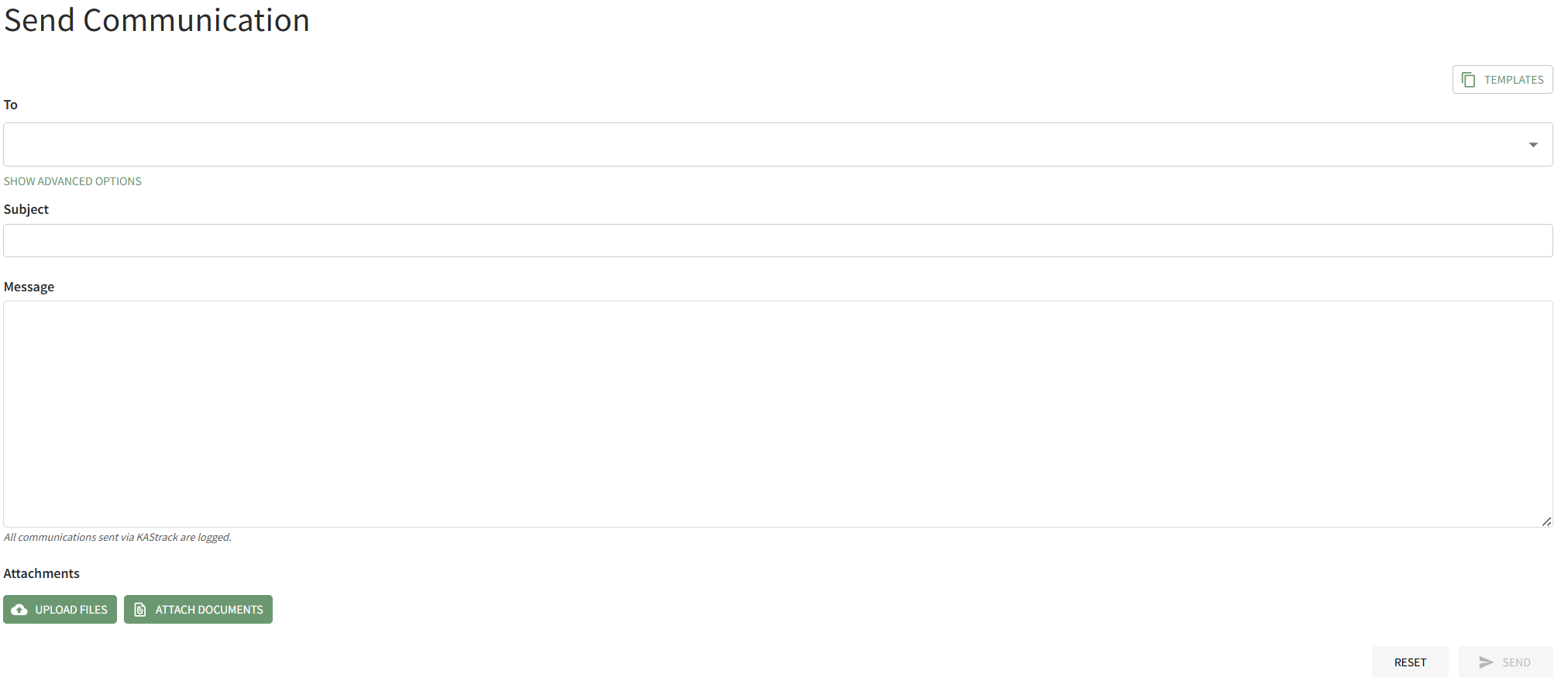
Select the Templates button on the right-hand side of the page above the To field. This opens the Templates Modal.
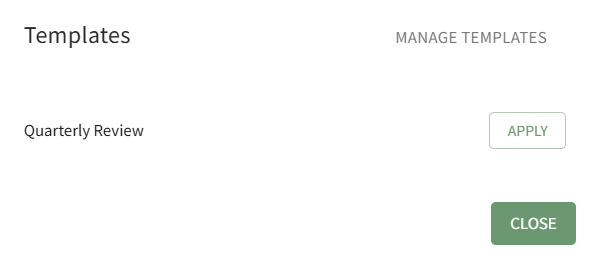
Click the Apply button to the right of the template you wish to use for the System Message.
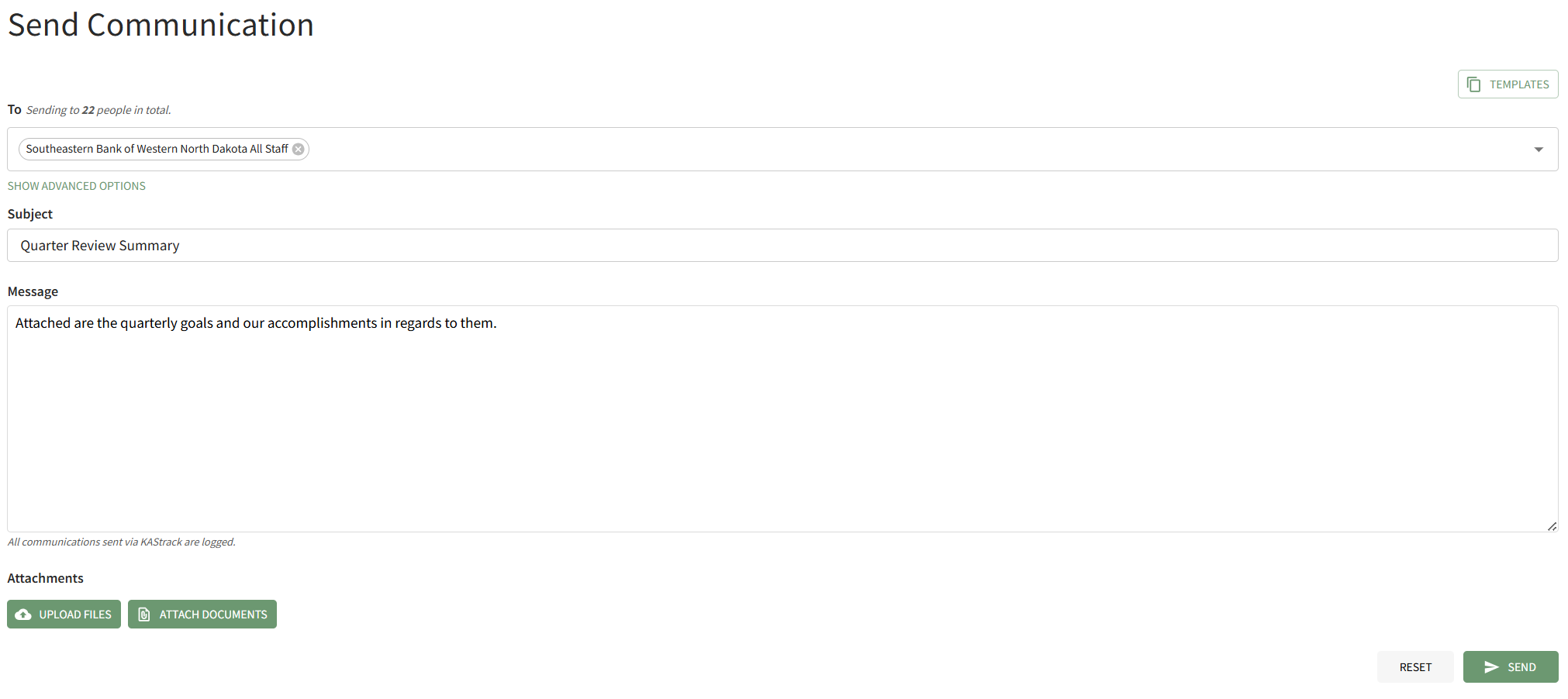
The Templates Modal automatically closes, and the selected template is applied to the Send Communications Page.
How To: View a Custom QR Code
To view a specific, custom QR Code, open the QR Code Page of the Communications Module from the Main Menu.
Click "View" in the QR Code Column to the right of the specific QR Code you wish to view.
This opens the QR Code Modal and displays the specified QR Code.